

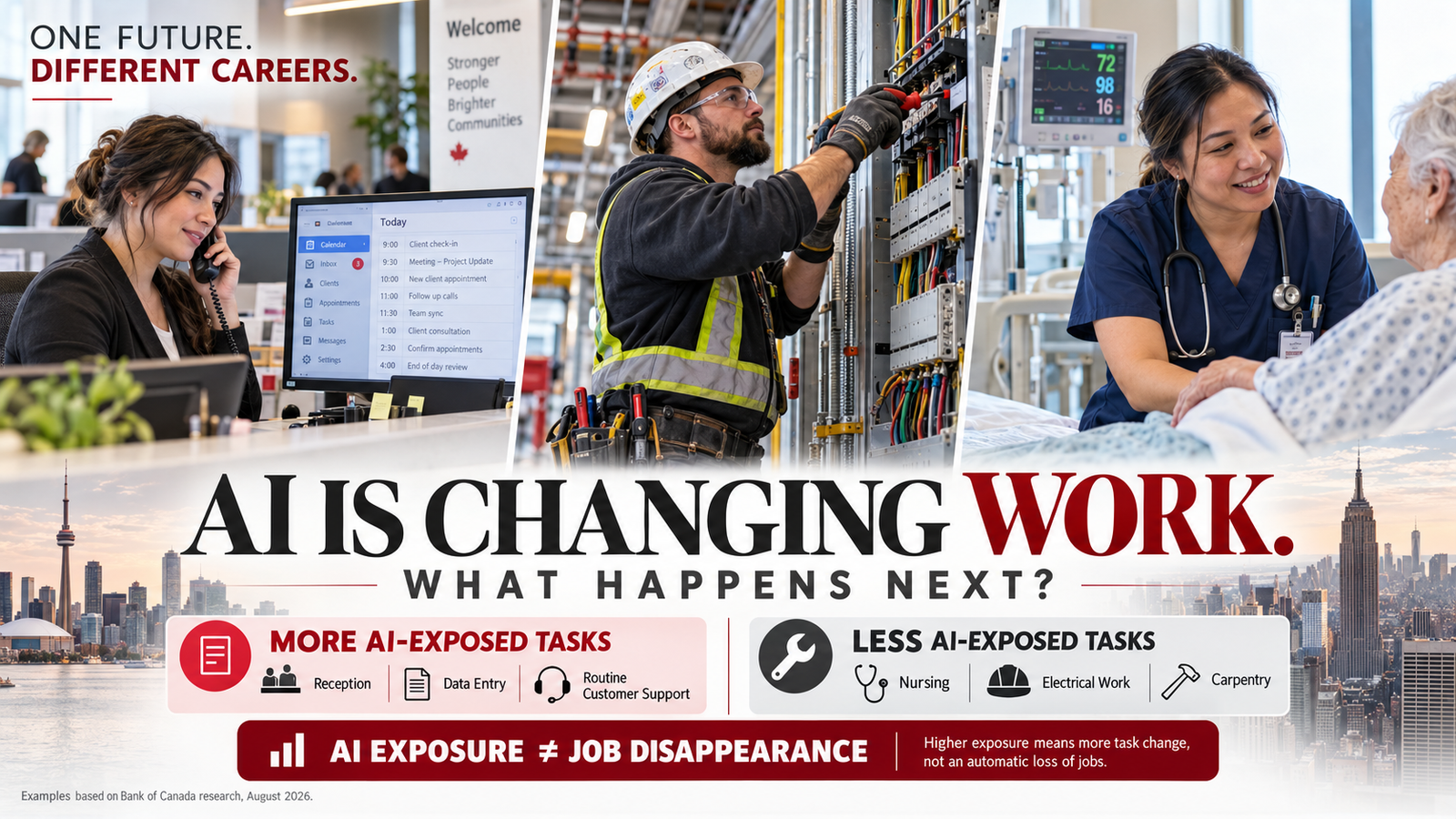
Will AI Replace Your Job by 2030? Careers at Risk and Growing Opportunities in Canada and the U.S.
Updated October 2026 | Career Trends, AI and the Future of Work
Will AI replace my job by 2030? It’s a question millions of workers are beginning to ask as artificial intelligence changes how businesses operate. From customer service and administration to healthcare, technology, and skilled trades, the future of work is already taking shape.
However, the answer is not as simple as predicting which jobs will disappear.
Imagine two professionals starting their day.
One works at a busy reception desk. An AI-powered system now handles routine bookings, answers common questions, and organizes incoming messages. As a result, the receptionist spends more time resolving unusual customer requests and coordinating office activities.
Meanwhile, an electrician arrives at a commercial building to investigate a complicated wiring problem. Although software helps identify possible faults, the actual repair still requires technical judgment, safety procedures, and hands-on expertise.
Both careers are being influenced by technology. Nevertheless, the impact is very different.
Recent research from the Bank of Canada, Statistics Canada, and the U.S. Bureau of Labor Statistics provides valuable insight into these changes.
In this guide, you’ll discover:
- Which occupations are more exposed to artificial intelligence.
- Five careers with strong U.S. employment growth projections.
- How Canadian wages compare across different career paths.
- Why some traditional occupations remain important.
- Which skills may help you adapt to workplace automation.
- How to prepare for career opportunities through 2030 and beyond.
Most importantly, you’ll learn how to make practical career decisions instead of relying on alarming headlines.
Will AI Replace My Job by 2030? What Research Actually Says
When people ask, “will AI replace my job by 2030?”, they often imagine an entire occupation disappearing overnight.
In reality, artificial intelligence typically affects individual tasks before it changes an entire job.
For example, AI systems can already help employees summarize documents, prepare reports, organize schedules, answer common questions, and analyze large datasets.
However, many occupations involve responsibilities that extend far beyond routine information processing.
A customer service professional may use AI to draft replies. Nevertheless, resolving sensitive complaints and earning customer trust still require judgment.
Similarly, a nurse may benefit from automated documentation while remaining responsible for patient assessment and clinical decisions.
What the Bank of Canada Found in 2026
In August 2026, the Bank of Canada published research on AI and Canada’s labour market.
The analysis suggested that some people seeking employment in occupations highly exposed to AI may be finding it harder to secure work.
However, researchers emphasized that these findings were early signals rather than definitive evidence that AI was causing widespread job losses.
Furthermore, Statistics Canada research published in January 2026 found that employment generally increased across occupations with different levels of AI exposure between November 2022 and December 2025.
These findings highlight an important distinction.
A job can be highly exposed to AI without being entirely replaceable by AI.
Therefore, workers should focus on understanding how their responsibilities may change rather than assuming their profession has no future.
Which Jobs Are Most Exposed to AI in Canada?
Some occupations contain more routine, predictable, and information-based tasks than others.
Consequently, AI systems may be able to assist with a larger proportion of the work performed in those roles.
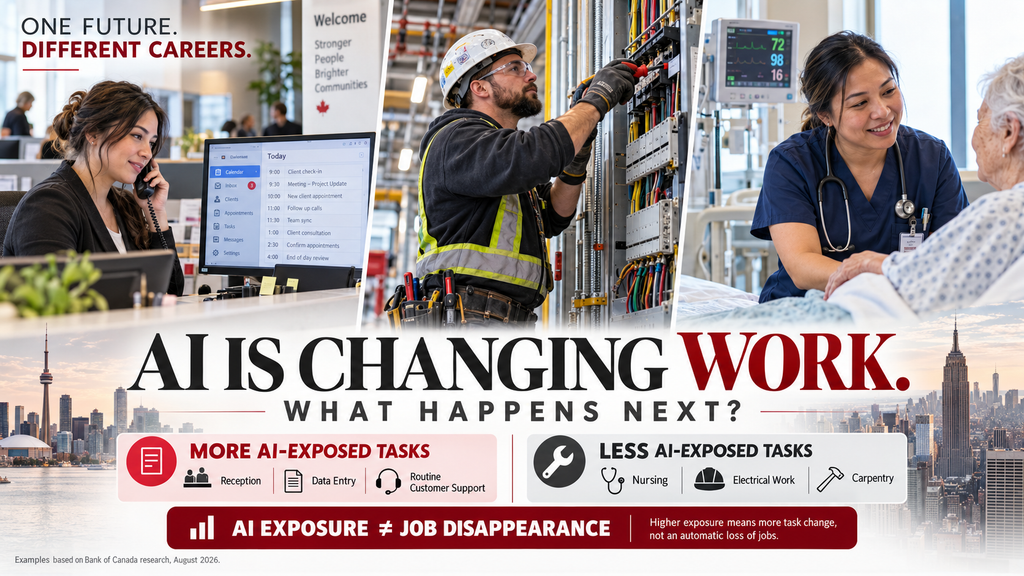
The Bank of Canada’s August 2026 analysis identified several examples of occupations with relatively high or low AI exposure.
Canadian Jobs With Higher and Lower AI Exposure
| More exposed to AI | Less exposed to AI |
|---|---|
| Data entry clerks | Nursing professionals |
| Receptionists | Electricians |
| Customer service representatives | Carpenters |
| Payroll and accounting clerks | Teachers |
| Travel agents | Physiotherapists |
| Office support workers | Roofers |
Source: Bank of Canada, August 2026. These are selected examples from occupational AI-exposure estimates, not predictions of job elimination. The two columns are not matching pairs.
Interestingly, many jobs performed primarily on computers appear among the more exposed occupations.
In contrast, several hands-on professions involve complex physical environments that current AI systems cannot independently manage.
Nevertheless, neither category guarantees a particular employment outcome.
A receptionist who develops stronger customer relationship, administrative coordination, and problem-solving skills may remain valuable.
Likewise, an electrician must continue learning as equipment, regulations, and digital diagnostic tools evolve.
What Does High AI Exposure Really Mean?
Consider a receptionist working in a medical clinic.
Previously, the employee might have spent much of the day answering routine telephone enquiries and manually scheduling appointments.
Today, appointment systems and AI-assisted customer support can handle some of those activities.
As a result, the receptionist may have more time to coordinate complex bookings, support visitors, communicate with healthcare staff, and resolve unusual situations.
The occupation still exists, but its most valuable responsibilities may shift.
For employers, this creates an opportunity to redesign roles thoughtfully.
For employees, it highlights the importance of identifying skills that remain useful even when routine tasks become automated.
If you’re exploring administrative careers, our guide to receptionist versus office coordinator responsibilities explains how these roles differ.
Will AI Replace My Job by 2030 If I Work in an Office?
If your concern is “will AI replace my job by 2030?”, start by examining the tasks you perform rather than focusing only on your job title.
For instance, imagine an administrative assistant whose daily responsibilities include entering information, preparing documents, organizing meetings, and coordinating between departments.
Some of these tasks are easier to automate than others.
| Workplace task | Potential AI assistance | Human value |
|---|---|---|
| Data entry | Extracting and organizing information | Checking accuracy and resolving exceptions |
| Scheduling | Suggesting meeting times | Managing conflicts and priorities |
| Customer emails | Preparing draft responses | Handling complex or sensitive requests |
| Reporting | Summarizing data | Interpreting findings and making decisions |
| Project coordination | Organizing updates and reminders | Resolving problems and aligning stakeholders |
Illustrative examples of possible AI assistance. Actual automation depends on the tools, workplace, data quality, and responsibilities involved.
Importantly, the table does not mean that every human task is immune to automation.
Instead, it shows why the ability to use technology responsibly can become an important professional advantage.
How Office Workers Can Become More Valuable
First, learn how to use AI tools to support your existing responsibilities.
Next, strengthen skills that involve judgment, accuracy, and communication.
For example, someone working in customer support could learn advanced complaint resolution, customer relationship management, and workflow improvement.
Meanwhile, an administrative assistant might develop reporting, process documentation, and project coordination skills.
In addition, employees who can check AI-generated outputs for errors may help organizations use automation more safely.
The goal is not simply to work faster.
Rather, it is to become more capable of handling responsibilities that require experience, adaptability, and reliable decision-making.
Five Careers With Strong Growth Projections Through 2035
Although artificial intelligence is creating uncertainty in some occupations, other career fields are projected to expand.
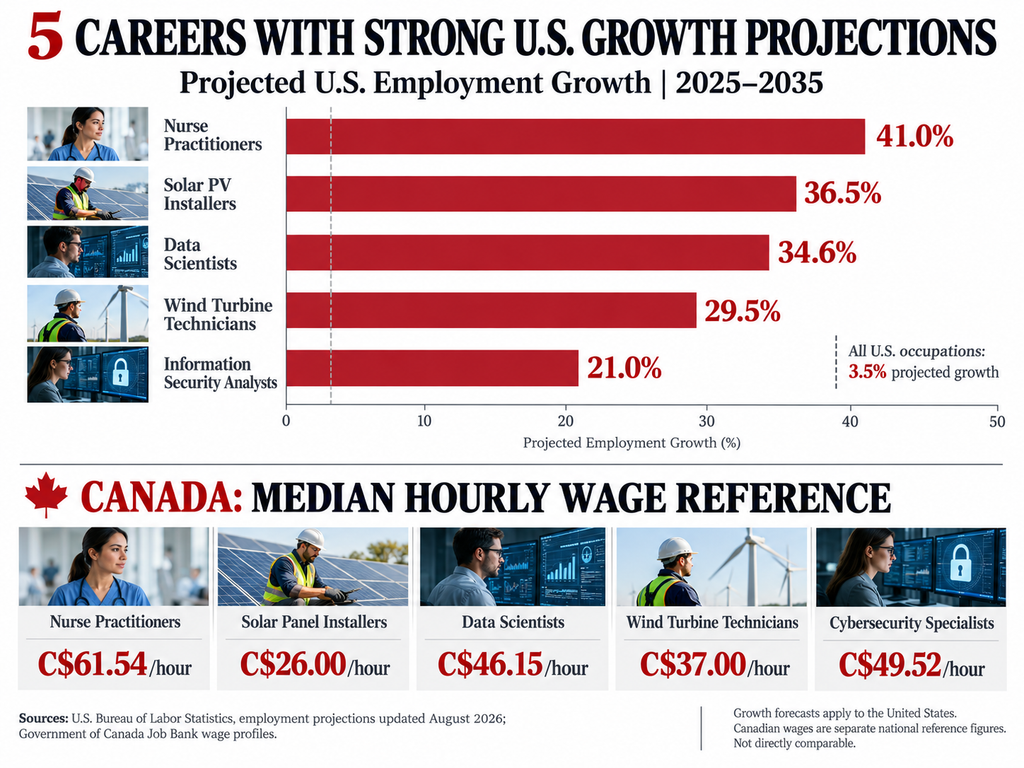
The U.S. Bureau of Labor Statistics released its updated employment projections for 2025–2035 in August 2026.
These forecasts provide a useful way to identify career fields worth researching.
However, they apply to the United States. Canadian employment growth, provincial demand, and licensing requirements must be assessed separately.
U.S. Job Growth and Salary Comparison
| Occupation | Projected U.S. growth, 2025–2035 | U.S. median annual pay, 2025 |
|---|---|---|
| Nurse practitioners | 41.0% | US$132,300 |
| Solar photovoltaic installers | 36.5% | US$53,140 |
| Data scientists | 34.6% | US$120,230 |
| Wind turbine service technicians | 29.5% | US$64,120 |
| Information security analysts | 21.0% | US$129,180 |
Source: U.S. Bureau of Labor Statistics — Fastest Growing Occupations. U.S. national employment growth is projected for 2025–2035; median annual pay is reported for 2025.
For comparison, total employment across all U.S. occupations is projected to increase by approximately 3.5% over the same period.
Therefore, these five fields show substantially higher projected percentage growth than the overall labour market.
Still, percentage growth is only one factor to consider. A smaller occupation can grow quickly while generating fewer total openings than a large, established profession.
Canadian Median Wage References
Canada’s Job Bank provides national wage information for corresponding or broadly related occupations.
| Career | Canadian median hourly wage |
|---|---|
| Nurse practitioners | C$61.54 |
| Solar panel installers | C$26.00 |
| Data scientists | C$46.15 |
| Wind turbine technicians | C$37.00 |
| Cybersecurity specialists | C$49.52 |
Source: Government of Canada Job Bank occupational wage profiles. These are Canadian hourly wage reference figures, not U.S. salary conversions or forecasts of future pay.
Important comparison note: U.S. salaries are reported annually in USD, while Canadian wages are reported hourly in CAD. Furthermore, some Canadian occupational classifications are broader than the corresponding U.S. categories, particularly solar panel installers and wind turbine technicians. Therefore, these figures should not be treated as directly equivalent occupation-level compensation comparisons.
Let’s examine why each career is worth considering.
1. Nurse Practitioners: Healthcare Careers With Strong Growth
Nurse practitioners appear at the top of the selected U.S. growth projections.
According to the BLS, employment in this occupation is projected to increase by approximately 41% between 2025 and 2035.
In Canada, the national median wage reported by Job Bank is C$61.54 per hour.
Nurse practitioners provide healthcare services, assess patient needs, support treatment decisions, and help manage ongoing medical conditions.
Although AI can assist with documentation and information analysis, professional clinical accountability remains essential.
Skills and qualifications to explore:
- Nursing education and clinical experience.
- Advanced professional qualifications.
- Patient assessment and communication.
- Clinical decision-making.
- Relevant provincial or state registration.
However, becoming a nurse practitioner generally requires extensive education and professional licensing.
Consequently, it may be suitable for someone planning a long-term healthcare career rather than a rapid transition from an unrelated field.
2. Solar Panel Installers: Growing Opportunities in Energy
Solar photovoltaic installation is another field with strong projected U.S. growth.
The BLS forecasts approximately 36.5% employment growth between 2025 and 2035.
In Canada, Job Bank reports a median hourly wage of C$26.00 for the broader occupational group associated with solar panel installers.
Unlike many traditional office jobs, this work takes place in physical environments.
Installers may assemble equipment, prepare mounting systems, inspect components, and help maintain solar installations.
As a result, technical knowledge and practical skills are particularly important.
Useful areas to explore:
- Electrical and installation fundamentals.
- Construction safety procedures.
- Equipment inspection.
- Technical troubleshooting.
- Apprenticeship and vocational training.
Before entering the field, investigate regional demand and local training requirements.
For example, opportunities in renewable energy can differ considerably between provinces and states.
3. Data Scientists: Building Careers Alongside AI
At first glance, data science presents an interesting contradiction.
Artificial intelligence can analyze information and generate computer code. Nevertheless, employment for data scientists is projected to grow significantly in the United States.
The BLS forecasts approximately 34.6% growth from 2025 to 2035.
In addition, its reported U.S. median annual wage for 2025 was US$120,230.
Canada’s Job Bank lists a national median wage of C$46.15 per hour for data scientists.
Why does this field remain relevant?
Because useful data science involves much more than generating charts or producing predictions.
Professionals must understand business problems, evaluate data quality, test assumptions, identify limitations, and communicate findings.
Furthermore, organizations need to understand whether AI-generated analyses are trustworthy.
Skills worth developing:
- Python and SQL.
- Statistics and probability.
- Data visualization.
- Data cleaning and validation.
- Machine learning fundamentals.
- Business analysis and communication.
For beginners, a practical portfolio project can be valuable.
For example, you could analyze a public dataset and create a dashboard that answers a clearly defined question.
Then explain how you validated your results and what limitations remain.
This demonstrates more than familiarity with software. It also shows your ability to think critically.
4. Wind Turbine Technicians: Technical Skills Meet Renewable Energy
Wind turbine service technicians are projected to experience approximately 29.5% U.S. employment growth between 2025 and 2035.
These professionals inspect equipment, diagnose mechanical problems, perform maintenance, and repair turbine systems.
Meanwhile, AI and digital monitoring can help identify unusual equipment behaviour.
However, many maintenance activities still require trained technicians working directly with physical machinery.
Useful skills and qualifications include:
- Mechanical and electrical fundamentals.
- Preventive maintenance.
- Industrial safety.
- Equipment diagnostics.
- Technical training and relevant certifications.
In Canada, the Job Bank wage reference of C$37.00 per hour comes from the broader construction millwrights and industrial mechanics occupational group.
Therefore, it should not be interpreted as a precise national wage specific to every wind turbine position.
The work may also involve heights, travel, and physically demanding conditions.
Before choosing this career, consider whether those requirements fit your preferences and circumstances.
5. Cybersecurity Specialists: Protecting Digital Businesses
Cybersecurity is another career field worth investigating.
As organizations become more dependent on digital platforms, protecting systems, accounts, and sensitive information remains a major responsibility.
The BLS projects approximately 21% employment growth for information security analysts between 2025 and 2035.
Furthermore, the U.S. median annual wage reported for 2025 was US$129,180.
In Canada, Job Bank reports a median hourly wage of C$49.52 for cybersecurity specialists.
However, cybersecurity is not necessarily an easy entry-level career.
Many positions require substantial technical foundations and experience.
Skills to develop include:
- Networking and operating systems.
- Identity and access management.
- Security monitoring.
- Incident investigation.
- Cloud security fundamentals.
- Risk assessment and reporting.
For example, IT support or systems administration experience can provide a foundation for more specialized security work.
In addition, practical experience through authorized training environments can help demonstrate technical ability.
The important lesson is that cybersecurity involves continuous learning because both defensive technologies and security threats evolve.
What About Electricians, Teachers, and Skilled Trades?
Not every promising career appears on a list of the fastest-growing occupations.
In fact, some jobs deserve attention because they combine practical expertise, professional judgment, and responsibilities that are difficult to automate.
The Bank of Canada’s 2026 research identifies several relatively less AI-exposed occupations, including electricians, carpenters, teachers, and nursing professionals.
Consider electrical work.
AI systems may assist with planning, estimating, and analyzing technical documentation.
Nevertheless, diagnosing faulty equipment and safely repairing installations in real environments requires hands-on expertise.
In Canada, Job Bank reports a national median hourly wage of C$35.00 for electricians, excluding industrial and power-system electricians.
Therefore, skilled trades may be worth exploring for people who prefer practical work over desk-based occupations.
However, lower AI exposure does not automatically guarantee strong local demand.
Regional construction activity, apprenticeships, licensing rules, and economic conditions also influence opportunities.
Before making a career decision, consult the Canadian Occupational Projection System and review provincial labour-market information.
How to Choose a Career Before 2030
Asking “will AI replace my job by 2030?” is only half of an effective career-planning strategy.
Equally important is identifying opportunities that match your abilities, resources, location, and interests.
Here are five factors to evaluate.
1. Local Employment Demand
First, investigate where the occupation is actually hiring.
A profession with strong projected U.S. growth may not have the same demand in every Canadian province.
For instance, employment opportunities in Toronto can differ from those in Calgary, Vancouver, Montreal, or smaller communities.
Therefore, use local labour-market information rather than relying exclusively on national rankings.
2. Total Job Openings
Next, compare projected growth percentages with the number of available positions.
A small occupation might grow by 30% but create relatively few jobs.
Meanwhile, a larger profession with slower percentage growth may generate more openings because of retirements and other replacement needs.
Consequently, both measures are useful.
3. Education and Licensing Requirements
Some careers require university education, practical training, professional licensing, or apprenticeships.
For example, nurse practitioners follow a regulated professional pathway.
By contrast, certain technical occupations offer vocational or apprenticeship routes.
Research the entry requirements before investing substantial money or time in training.
4. Salary and Cost of Living
A high salary does not automatically make a career financially attractive.
You should also consider taxes, housing, benefits, education costs, and working hours.
Moreover, compensation varies significantly by location and experience.
Use Canadian wage data for Canadian jobs and U.S. salary data for U.S. jobs.
5. Your Strengths and Interests
Finally, consider the everyday responsibilities of the occupation.
Some people enjoy technical troubleshooting. Others prefer healthcare, communication, analysis, management, or creative work.
A sustainable career should align with your abilities and interests—not only with a headline about future salaries.
Will AI Replace My Job by 2030? A Practical 30-Day Preparation Plan
You cannot control every technological development.
However, you can take practical steps to strengthen your career prospects.
To turn the question “will AI replace my job by 2030?” into an actionable plan, begin with the following four-week process.
Week 1: Review Your Current Responsibilities
Start by listing the 10 tasks you perform most frequently at work.
Then divide them into three categories:
- Routine tasks that could be standardized or automated.
- Tasks where AI could improve your productivity.
- Tasks that depend strongly on human judgment, communication, or physical expertise.
For example, preparing a standard report may be easier to automate than resolving a complicated customer dispute.
Afterward, identify two skills that could make your work more valuable.
Week 2: Research Three Career Options
Choose three occupations that interest you.
Next, review approximately 10 relevant job advertisements for each career.
Pay attention to recurring qualifications, technical requirements, experience expectations, and salary ranges.
Use resources such as Canada Job Bank and the U.S. Occupational Outlook Handbook.
In addition, compare roles in the cities or regions where you are legally eligible to work.
This process can help you distinguish real employer requirements from general career trends.
Week 3: Build a Demonstrable Skill
Select one skill that appears repeatedly in relevant job descriptions.
For example, an administrative professional might learn advanced spreadsheet reporting.
A customer service worker could develop CRM knowledge and service process documentation.
Meanwhile, an aspiring data analyst might build a small dashboard using publicly available information.
The objective is to complete something practical.
Therefore, focus on a small project you can explain clearly to an employer.
Week 4: Improve Your Résumé and Career Profile
Finally, update your résumé using accurate descriptions of your achievements.
Whenever possible, show the results of your work rather than simply listing responsibilities.
For example:
Basic résumé statement:
“Answered customer questions and scheduled appointments.”
Stronger résumé statement:
“Coordinated customer appointments, resolved non-routine service enquiries, and maintained accurate records while supporting daily front-desk operations.”
The second version provides more context about the candidate’s responsibilities.
However, only describe work you have actually performed.
If you need additional guidance, read our article about building a stronger career profile with Canada Prime Jobs.
Once your profile is ready, begin applying to suitable opportunities and track the results.
How Employers Can Prepare for AI and Future Workforce Changes
Artificial intelligence is not only changing career planning for employees.
It is also influencing how organizations approach recruitment, training, and workforce development.
For employers, the first step is to understand which workplace activities can benefit from automation.
However, replacing an entire role without examining its responsibilities may create new operational problems.
Focus on Tasks Before Job Titles
Consider a company that employs customer service representatives.
AI software might handle common enquiries and organize support messages.
Nevertheless, difficult complaints, unusual requests, and important customer relationships may still require experienced employees.
Therefore, businesses should evaluate individual responsibilities before making staffing decisions.
Hire for Adaptability and Practical Skills
Next, consider which skills employees will need as technology changes.
For example, communication, problem-solving, data interpretation, technical literacy, and professional judgment can remain valuable across different industries.
In addition, training current employees may be an alternative to recruiting entirely new teams.
A thoughtful workforce strategy should account for both technology and people.
Improve Recruitment Planning
Before publishing a vacancy, employers should identify the business problem the new employee is expected to solve.
They should also distinguish mandatory qualifications from skills that can be learned.
For a practical starting point, read our smarter hiring checklist for employers.
Although the examples focus on Vancouver workplaces, many of the recruitment principles apply more broadly.
Frequently Asked Questions About AI and Jobs
Will AI replace my job by 2030?
No reliable research can determine whether your specific job will be replaced by 2030. The outcome depends on your responsibilities, industry, employer, location, and the development of AI technology. However, workers can prepare by strengthening practical, technical, and interpersonal skills.
Which jobs are most exposed to AI in Canada?
According to the Bank of Canada’s August 2026 analysis, occupations with relatively high exposure include data entry clerks, receptionists, payroll and accounting clerks, travel agents, and customer service representatives. Nevertheless, high exposure does not mean every position will disappear.
Which careers are projected to grow the fastest?
Among the occupations highlighted by the U.S. Bureau of Labor Statistics, nurse practitioners, solar photovoltaic installers, data scientists, and wind turbine service technicians have particularly strong projected percentage growth from 2025 to 2035. However, these are U.S. forecasts and should not be used as Canadian employment projections.
Are skilled trades safer from AI?
Some skilled trades have lower estimated AI exposure because they involve physical environments, specialized equipment, and hands-on problem-solving. Still, technology can change their workflows, and future employment depends on many factors beyond AI.
Can I change careers without a university degree?
Yes, depending on the occupation. Apprenticeships, vocational programs, employer training, and practical experience may provide access to certain careers. However, regulated professions such as nursing require specific educational and licensing qualifications.
Should I learn AI tools to protect my career?
Learning relevant AI tools can be useful, especially when your employer is adopting them. However, technical tools should complement your existing professional skills. Accuracy, communication, accountability, and judgment remain important.
Where can I find reliable information about Canadian and American careers?
For Canada, start with Job Bank and official occupational forecasts.
For the United States, use the Bureau of Labor Statistics Occupational Outlook Handbook.
These sources provide employment information, occupational descriptions, wages, and career requirements.
Final Thoughts: Prepare for Change Instead of Predicting the Future
Artificial intelligence will continue influencing the way people work.
However, the future is unlikely to be divided neatly into occupations that disappear and occupations that remain unchanged.
Instead, many roles may evolve as technologies automate particular tasks and create new ways of working.
For employees, this means developing adaptable skills and understanding where employment opportunities may emerge.
Meanwhile, employers can benefit from combining useful technology with strong human expertise.
If you’re still wondering, “will AI replace my job by 2030?”, focus on something more actionable:
What can I learn today that will make me more valuable tomorrow?
Your next career opportunity may not require abandoning everything you already know.
Sometimes, the strongest career move is to build on your existing experience while preparing for new responsibilities.
Explore Career Opportunities With Canada Prime Jobs
Whether you’re researching a new profession, planning a career change, or preparing to take your next professional step, staying informed is an important place to begin.
Visit Canada Prime Jobs for career resources and recruitment information.
You can also explore job listings on CPJ to review available opportunities.
Your experience matters. Your ability to adapt can make it even more valuable.
Sources and Research References
The following publicly available sources were reviewed in October 2026.
Canadian AI and labour-market research
- Bank of Canada — Early Signs of AI-Driven Adjustments in Canada’s Labour Market (August 2026)
- Statistics Canada — Canadian Employment Trends in the Era of Generative Artificial Intelligence (January 2026)
- Canadian Occupational Projection System
U.S. employment and salary data
Canadian occupational wage information
- Nurse Practitioners — Job Bank
- Solar Panel Installers — Job Bank
- Data Scientists — Job Bank
- Wind Turbine Technicians — Job Bank
- Cybersecurity Specialists — Job Bank
- Electricians — Job Bank
Editorial note: Employment projections are estimates rather than guarantees. Canadian wage figures reflect Job Bank’s published survey-based wage data and should not be interpreted as future wage forecasts. Occupational classifications, training requirements, and employment conditions vary by region.




One Response