


Fake Job Postings in 2026: 9 Red Flags, Ghost Jobs and a 5-Minute Verification Guide
Published October 2026 | Job Search Safety in Canada and the United States

Fake job postings are becoming harder to recognize. In 2026, a suspicious opportunity might look like a polished advertisement, include a familiar company logo, involve a professional-looking recruiter, and even come with an official-looking employment contract.
But what happens when the job was never available—or the person offering it does not actually work for the company?
Imagine spending an evening preparing an application for a remote position. The salary sounds attractive, the employer appears legitimate, and the recruiter responds almost immediately.
Then something unusual happens.
The recruiter asks you to continue on a private messaging app, provide banking information, or pay a small fee to activate your employment account.
Would you recognize the warning signs before sharing your information?
Unfortunately, these situations are not just hypothetical.
A new October 2026 survey by iHire found that 38.7% of 683 job seekers surveyed said they had encountered what they believed was a fake, fraudulent, or scam job posting.
Meanwhile, the Canadian Anti-Fraud Centre warned in March 2026 that employment fraud can involve convincing interviews, contracts, training materials, and malicious applications.
The good news? You can develop a simple verification habit that helps you identify suspicious opportunities before you invest time, share sensitive information, or send money.
In this guide, you will learn how to spot fake job postings, understand the difference between ghost jobs and employment scams, and use a practical five-minute checklist before applying.
Fake Job Postings vs. Ghost Jobs: What’s the Difference?
People often use the terms fake job posting, ghost job, and recruitment scam interchangeably.
However, they can describe very different situations.
Understanding the distinction matters because the appropriate response may also be different.
Three Types of Job Listings You Should Know
| Type | What it means | Main concern | Recommended response |
|---|---|---|---|
| Ghost job | A position advertised without a genuine current intention to fill it | Wasted time and misleading expectations | Confirm whether recruitment is active |
| Fraudulent job posting | A fabricated opportunity designed to deceive applicants | Financial loss or identity theft | Stop sharing information and report it |
| Outdated or filled vacancy | A genuine position that has closed but remains visible online | Unnecessary applications | Check the current vacancy status |
Important: An unanswered application or an older advertisement is not automatically evidence of fraud or a ghost job.
For example, a company may have paused recruitment because of a budget change. Alternatively, an advertised position may have been filled while an external website still displays an older copy.
Those situations can be frustrating, but they do not necessarily indicate criminal activity.
A ghost job, by contrast, generally refers to an advertised position that the employer does not currently intend to fill.
A fraudulent listing is more serious. It may have been created by someone impersonating an employer to obtain money, personal data, or access to a device.
Why Ghost Jobs Matter in 2026
The problem is significant enough to influence how people perceive recruitment platforms.
In its 2026 State of Online Recruiting report, iHire found that 39.3% of surveyed U.S. job seekers identified fake, fraudulent, or ghost jobs as a major job-search frustration.
Furthermore, 42.8% reported difficulty determining whether a job or employer was legitimate on a recruiting platform.
The research surveyed 1,054 job seekers and 318 employers across 57 U.S. industries.
These numbers represent respondents’ experiences and perceptions, not the percentage of all job advertisements that are fraudulent.
Nevertheless, the findings demonstrate why job-posting transparency and independent verification matter.
9 Red Flags That May Reveal Fake Job Postings
No single clue can reliably identify every suspicious opportunity.
However, the following warning signs deserve attention—especially when several appear together.
1. You Receive an Unexpected Job Offer With Almost No Details
Picture receiving a message that says:
“Hello! We have a remote position available. Flexible hours. Excellent daily pay. Reply YES if interested.”
It sounds convenient.
However, the message does not explain the company, actual responsibilities, required experience, or recruitment process.
In April 2026, the U.S. Federal Trade Commission warned about unsolicited job-offer texts, including messages from fake recruiters asking recipients to reply with words such as “YES” or “INTERESTED.”
What to do: Avoid responding to unexplained job offers from unfamiliar senders. Instead, independently research the organization and its official hiring channels.
A legitimate recruiter can contact someone unexpectedly, but the identity and opportunity should be verifiable.
2. The Recruiter’s Identity Does Not Match the Company
A familiar company name is not enough to prove authenticity.
Scammers sometimes impersonate employees of established organizations and use realistic signatures, profile photographs, and corporate-style documents.
For example, a recruiter may claim to represent a well-known business while communicating through an unrelated personal email address.
That discrepancy deserves investigation.
However, not every legitimate recruiter uses an employer’s own email domain. External recruitment agencies may operate through their own business domains.
What to check:
- Does the sender’s email domain match the stated organization or agency?
- Can you independently confirm the recruiter works there?
- Is the vacancy listed on a credible official channel?
- Can you reach the employer using contact details obtained independently?
Never rely solely on the telephone number or website supplied in a suspicious message.
3. You Cannot Verify That the Position Exists
One useful way to check fake job postings is to look for independent evidence of the opening.
Start with the employer’s official careers page.
Next, compare the job title, location, responsibilities, and application instructions with the advertisement you found elsewhere.
If the employer uses a recruitment agency, look for a credible connection between that agency and the assignment.
However, the absence of a vacancy from a public careers page is not conclusive proof of fraud. Some organizations recruit confidentially, use third-party recruiters, or remove listings after a deadline.
Better approach: Ask the employer whether the specific vacancy is currently accepting applications.
If you cannot independently confirm the opportunity, avoid sharing sensitive information until the uncertainty is resolved.
4. You Are Offered a Job Before Any Meaningful Assessment
Some employers legitimately use short hiring processes, especially for urgent or entry-level recruitment.
However, an offer that arrives almost immediately, without a credible discussion of responsibilities or qualifications, can be suspicious.
Be especially cautious when the process involves only brief messaging conversations followed by a sudden request for financial information.
For example:
“You have been selected. We only need your banking details to complete onboarding.”
A genuine hiring process should provide enough information for both sides to understand the position and confirm the relationship.
What to do: Verify the employer independently before accepting paperwork, supplying confidential information, or changing your financial arrangements.
5. The Employer Asks You to Pay to Receive a Job
This is one of the strongest warning signs.
A supposed recruiter might request payment for:
- Access to a hiring platform.
- Mandatory employment activation.
- A refundable security deposit.
- Equipment purchased through a specified seller.
- Cryptocurrency needed to unlock earnings.
- A fee to release salary or commissions.
The FTC explicitly warns against paying to get a job or paying money to receive supposedly earned income.
Therefore, never send money to an unverified recruiter in exchange for an employment opportunity.
Be particularly careful when payment must be made through cryptocurrency, gift cards, or unfamiliar payment platforms.
Legitimate professional training programs may charge tuition, and some licensing processes involve official fees. However, those are not the same as sending money to an unknown recruiter to secure or unlock a job.
6. Someone Requests Sensitive Personal Information Too Early
A real employer may eventually need identity and financial information for lawful payroll, tax, or onboarding purposes.
However, the timing and communication channel matter.
Canada’s Job Bank safety guidance advises applicants not to include sensitive details such as Social Insurance Numbers, banking information, or identification numbers in résumés or ordinary interviews.
Similarly, U.S. authorities warn about fake recruiters requesting Social Security numbers and bank account details before candidates have been legitimately hired.
Do not place the following in a public résumé:
- Canadian Social Insurance Number (SIN).
- U.S. Social Security number (SSN).
- Bank account or credit card details.
- Personal identification documents.
- Passwords or authentication codes.
If legitimate onboarding requires sensitive information later, independently verify the employer and use its authorized secure process.
7. The Work Involves Easy Online Tasks and Unusual Commissions
This is one of the most concerning types of modern employment fraud.
A recruiter might promise compensation for activities such as reviewing products, increasing app visibility, rating content, or completing simple optimization tasks.
At first, the platform may display earnings.
Sometimes, the operator may even send a small initial payment to build trust.
Later, the worker is told to deposit money or cryptocurrency to unlock additional tasks or withdraw the displayed balance.
These schemes are often called task scams.
The FTC and Canadian Anti-Fraud Centre have both warned about variations of this fraud.
If an online job requires you to deposit your own money to release supposed earnings, stop participating.
You should never need to fund an employer-controlled account to receive your salary.
8. You Are Sent a Cheque and Told to Purchase Equipment
Imagine receiving an offer for a remote administrative position.
The recruiter says the company will provide a home-office setup.
Then you receive a cheque and instructions to deposit it before paying a designated equipment supplier.
The cheque may initially appear to clear. However, it can later be identified as fraudulent, leaving you responsible for the money you sent.
The FTC has specifically warned about this type of fake-cheque employment scam.
Another variation involves receiving, repackaging, and forwarding parcels on behalf of an supposed employer.
These arrangements can be associated with reshipping fraud.
What to do: Do not transfer money, forward packages, or purchase equipment at a supposed employer’s direction unless the arrangement has been independently verified.
9. You Are Pressured to Install an Unfamiliar App or Share Login Credentials
Employment scammers are increasingly using realistic digital infrastructure.
In March 2026, the Canadian Anti-Fraud Centre warned that fraudulent hiring processes can involve malicious apps presented as employee tools, communication platforms, or payment systems.
An applicant might receive instructions to install software before an interview or create an account on a suspicious website.
The software may be designed to capture information or facilitate financial theft.
Warning signs include:
- Unverified software downloads.
- Requests to disable device security.
- Pressure to provide account passwords.
- Unexplained requests for authentication codes.
- Links to unfamiliar payment or cryptocurrency platforms.
Before installing anything, verify the company, the software publisher, and the reason it is needed.
Remember: Professional-looking design does not prove that an offer is legitimate.
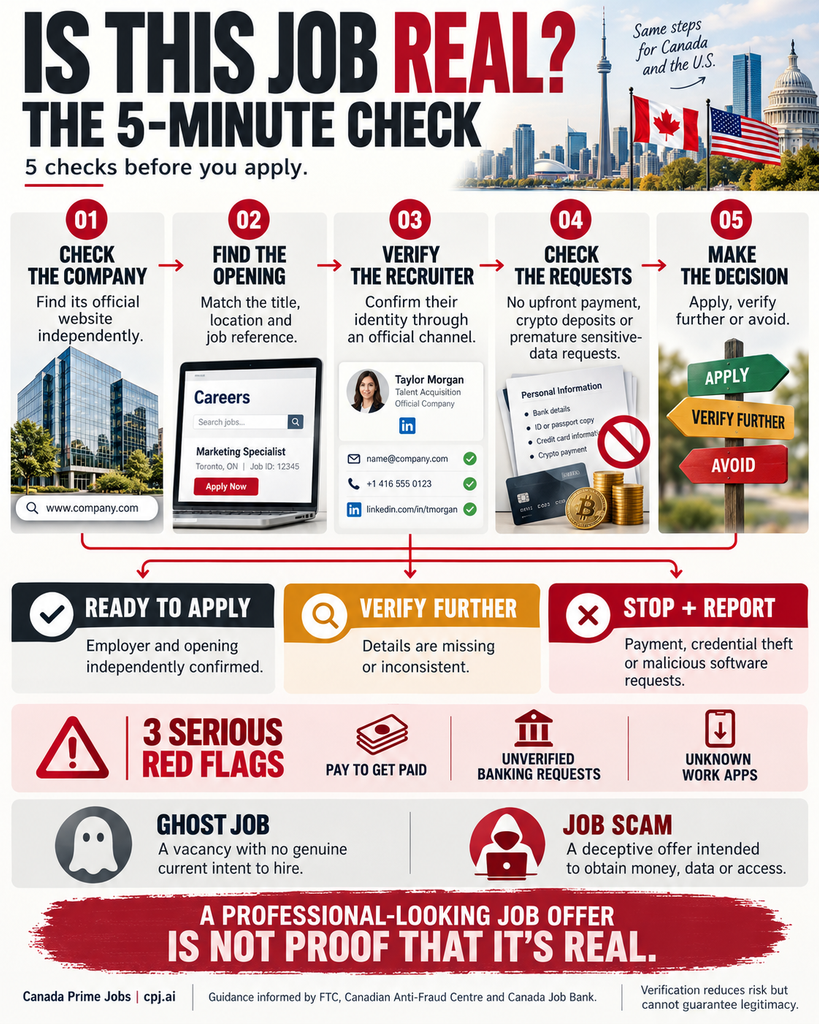
The 5-Minute Job Posting Verification Checklist
You do not need to become a cybersecurity specialist to evaluate an unfamiliar opportunity.
Instead, use this five-step process before submitting your application.
Minute 1 — Confirm the Employer Exists
Search for the company’s official website using your browser rather than clicking an unfamiliar message link.
Check whether the company provides meaningful information about its activities, location, and contact methods.
Compare that information with the job advertisement.
A professional website alone is not proof of legitimacy, but inconsistencies are worth investigating.
Minute 2 — Look for the Actual Vacancy
Find the employer’s careers page or another officially recognized recruiting channel.
Compare the job title, employment location, responsibilities, and application instructions.
If there is a job reference number, record it.
When the vacancy is not publicly listed, contact the organization independently to confirm that recruitment is active.
Minute 3 — Verify the Recruiter
Search the recruiter’s name and professional affiliation.
If the person claims to represent an agency, investigate the agency as well.
Then confirm the relationship through an independently obtained corporate contact channel.
A legitimate professional profile is useful context, but profiles and identities can be impersonated.
Minute 4 — Check for Money and Sensitive Data Requests
Ask yourself:
- Am I being asked to send money before starting work?
- Does the recruiter want sensitive identity or banking information before legitimate onboarding?
- Am I required to download an unfamiliar application?
- Is the job based on depositing money to unlock earnings?
If the answer is yes, stop and investigate.
Minute 5 — Decide Whether to Apply, Verify Further, or Avoid
Use the following practical decision guide.
| Your findings | Recommended action |
|---|---|
| Employer, vacancy, and recruiter independently confirmed; no major warning signs | Proceed with normal application precautions |
| Employer appears real, but vacancy status is unclear | Ask for confirmation before sharing further details |
| Multiple inconsistencies or unexplained pressure | Pause, investigate, and avoid sharing sensitive information |
| Payment, crypto deposits, fake cheques, or credential theft requests | Stop engagement and report the suspicious activity |
This checklist is a practical screening tool, not a guarantee that a listing is safe.
A short verification process may save you significant time—and help protect your financial and personal information.
What Does a Suspicious Recruiter Message Look Like?
To make the warning signs easier to recognize, compare these two fictional examples.
Example A: Suspicious Job Message
“Hello candidate. You have been selected for our remote optimization role. Earn $300 daily with no experience. Reply immediately to activate your account. A deposit is required to unlock your first payment.”
Why it raises concerns:
The company and role are unclear, compensation is presented without meaningful context, the message creates urgency, and the applicant is expected to pay money before receiving earnings.
Example B: A More Verifiable Recruitment Message
“Hello Jordan,
I’m contacting you about the Operations Coordinator position at Example Company.
The vacancy is listed on our official careers page under reference OC-204.
You can review the responsibilities and application requirements through our company website.
Please let me know if you would like additional information about the role.”
Why this is easier to verify:
The message identifies a specific position and provides a job reference that the applicant can independently check.
However, even a well-written message should not be treated as verified until the organization and vacancy are confirmed.
Both messages are invented examples for education, not evidence of actual hiring activity.
How to Ask Whether a Job Posting Is Still Active
Sometimes the opportunity looks genuine, but the advertisement has been online for weeks.
That does not automatically mean it is a ghost job.
For example, a company may be recruiting multiple people, waiting for approvals, or conducting a longer search.
Instead of guessing, ask a concise and professional question.
Suggested message:
“Hello,
I’m interested in the [Job Title] position listed by your organization.
Before submitting my application, could you please confirm whether recruitment for this role is currently active and whether applications are still being accepted?
Thank you for your time.”
Send the enquiry through an official, independently verified contact channel.
If no confirmation is available, you can decide whether the opportunity deserves further time based on your other options.
An unanswered enquiry is a reason for uncertainty—not proof of fraud.
What If You Already Responded to a Fake Recruiter?
If you suspect you’ve encountered a fraudulent job posting, act according to the information or money involved.
If You Only Sent a Basic Résumé
Stop communicating with the suspicious sender.
Check whether the résumé contains sensitive personal details that should not have been shared.
Save relevant messages and consider reporting the listing to the platform.
Remain alert to follow-up phishing attempts.
If You Shared Passwords or Authentication Codes
Change affected passwords through the genuine website or app.
Secure your email account first if it may have been compromised.
Enable multifactor authentication where possible and review account access activity.
If You Sent Money or Banking Information
Contact your financial institution or payment provider immediately.
Explain what happened and ask what protective or recovery actions may be available.
Preserve records of payments, messages, account details, and relevant websites.
If You Shared Sensitive Identity Information
Seek jurisdiction-specific identity theft guidance.
For U.S. residents, the FTC provides information and individualized recovery steps through IdentityTheft.gov.
In Canada, the Canadian Anti-Fraud Centre provides reporting guidance, and affected individuals should also contact local police when appropriate.
Where to Report Suspicious Recruitment Activity
| Location | Official reporting resource |
|---|---|
| Canada | Canadian Anti-Fraud Centre — Report Fraud and Cybercrime |
| United States | FTC — ReportFraud.gov |
| U.S. identity theft | IdentityTheft.gov |
| The job platform | Use its official reporting or support process |
You do not have to lose money to report a suspected scam.
Reporting suspicious activity can help authorities and recruitment platforms identify recurring patterns.
What Employers Can Do to Make Legitimate Job Ads More Trustworthy
Job seekers are not the only people affected by recruitment fraud.
Employers can also experience impersonation, misleading advertisements using their company identity, and fraudulent applications.
In iHire’s 2026 State of Online Recruiting report, 23.6% of the 318 employers surveyed said they had received at least one fake or fraudulent applicant in the previous year.
Consequently, recruitment transparency matters on both sides.
Five Ways Employers Can Build Confidence
1. Keep vacancy statuses accurate.
Close or update advertisements when positions are filled, paused, or cancelled.
2. Use identifiable application channels.
Direct applicants toward recognizable company websites or clearly identified recruiting partners.
3. Explain the role clearly.
Include meaningful responsibilities, location, employment arrangement, and compensation information where appropriate or required.
4. Make legitimate recruiter identities verifiable.
Help applicants understand which business domains, agencies, or contact channels your organization uses.
5. Communicate the hiring process.
Explain the main recruitment stages and clarify when sensitive onboarding information may legitimately be requested.
These practices do not eliminate fraud. However, they give candidates better information for distinguishing genuine opportunities from suspicious ones.
For additional guidance, explore our employer hiring checklist, which explains how to define responsibilities and prepare job advertisements more effectively.
A Smarter Job Search Is About Quality, Not Just Quantity
When job searching becomes difficult, it can be tempting to apply to as many advertisements as possible.
However, sending more applications is not necessarily the same as finding more genuine opportunities.
A practical alternative is to track the quality of your search.
Consider creating a simple application log.
| Date | Employer | Position | Verified opening? | Application status |
|---|---|---|---|---|
| Oct. 28 | Example Company A | Operations Assistant | Yes, confirmed | Applied |
| Oct. 28 | Example Company B | Customer Service | Awaiting confirmation | Not submitted |
| Oct. 29 | Example Company C | Data Analyst | Yes, official careers page | Preparing résumé |
All company names and entries above are fictional examples.
This approach can help you avoid repeated applications to questionable listings.
Furthermore, keeping a record of each opportunity helps you follow up more effectively.
Once you find a credible position, focus on showing the employer why your skills fit the actual responsibilities.
Our related guide, Will AI Replace Your Job by 2030?, explores how workplace skills and career opportunities are changing across Canada and the United States.
If you’re developing your résumé, you can also read our customer service skills guide for examples of describing transferable experience honestly.
Frequently Asked Questions About Fake Job Postings
How can I spot fake job postings in Canada?
Check the employer’s official website, independently verify the vacancy and recruiter, and avoid requests for upfront payment or sensitive information before legitimate onboarding. Canada’s Job Bank and Canadian Anti-Fraud Centre provide official safety guidance.
Are all remote jobs suspicious?
No. Remote work is a legitimate employment arrangement across many industries. However, fraudsters also advertise fake remote opportunities, so applicants should independently verify unfamiliar employers and offers.
What is a ghost job?
A ghost job is generally an advertised position that the employer does not genuinely intend to fill at that time. However, an outdated listing or lack of response does not prove that a job is a ghost job.
Is a job posting fake if it has been online for more than 30 days?
Not necessarily. Some legitimate roles have long recruitment timelines, require specialized skills, or remain open for multiple hires. Check the current status rather than relying on an arbitrary posting-age rule.
Can fake recruiters use real company logos and names?
Yes. Scammers can impersonate legitimate companies through fake profiles, messages, websites, and documents. Therefore, a familiar logo or professional-looking contract is not sufficient evidence of authenticity.
Should I provide my SIN or SSN during a job application?
Do not place your SIN or SSN in a public résumé or provide it casually to an unverified recruiter. Legitimate employment processes may require sensitive information at appropriate stages, but applicants should verify the employer and use authorized, secure channels.
What should I do if a recruiter asks for cryptocurrency?
Be extremely cautious. A requirement to deposit cryptocurrency to unlock job tasks, commissions, or employment earnings is a serious fraud warning sign. Stop the transaction and independently investigate the supposed employer.
Final Thoughts: Verify First, Apply With Confidence
The job market is changing, and digital recruitment can make discovering opportunities easier.
Unfortunately, the same technology can also make misleading advertisements and fraudulent recruitment messages look more convincing.
That does not mean every unfamiliar advertisement is dangerous.
Instead, job seekers should learn to recognize warning signs, verify employers independently, and protect sensitive information.
For employers, clear and accurate recruitment communication can strengthen trust before an interview even begins.
The most important job-search habit is simple: verify the opportunity before you trust the offer.
A few minutes of careful research may help you avoid wasting time on ghost jobs or exposing yourself to a recruitment scam.
Continue Your Career Search With Canada Prime Jobs
Canada Prime Jobs provides career resources and recruitment information for people exploring opportunities in Canada.
You can browse the CPJ jobs directory and review the available listings. Always confirm that a specific position is still open before applying, regardless of which platform you use.
For more career guidance and recruitment resources, visit Canada Prime Jobs.
Stay curious. Stay informed. And never let urgency replace verification.
Sources and Editorial Research
Information reviewed in October 2026. Survey results describe the sampled respondents, not the prevalence of fraud across all Canadian or U.S. job listings.
Recent recruitment research
- iHire — Survey on Fake and Scam Job Postings, October 20, 2026
- iHire — The State of Online Recruiting 2026
Canadian government guidance
- Canadian Anti-Fraud Centre — The Sophistication of Fraud, March 2026
- Canadian Anti-Fraud Centre — Job Scams
- Canada Job Bank — Job Search Safety Tips
United States consumer protection
- FTC — That Job Offer Text Is Probably a Scam, April 2026
- FTC — Job Scammers Are Looking to Hire You
- FTC — How to Spot and Avoid Task Scams
- FTC — What to Do If You Were Scammed
This article provides general educational information. Hiring practices, reporting procedures, and legal requirements vary by jurisdiction.