
High-Volume Hiring in 2026: How to Recruit 10–50 Employees Without Losing Great Candidates
An Employer and Job Seeker Guide for Canada and the United States | Research Reviewed November 2026
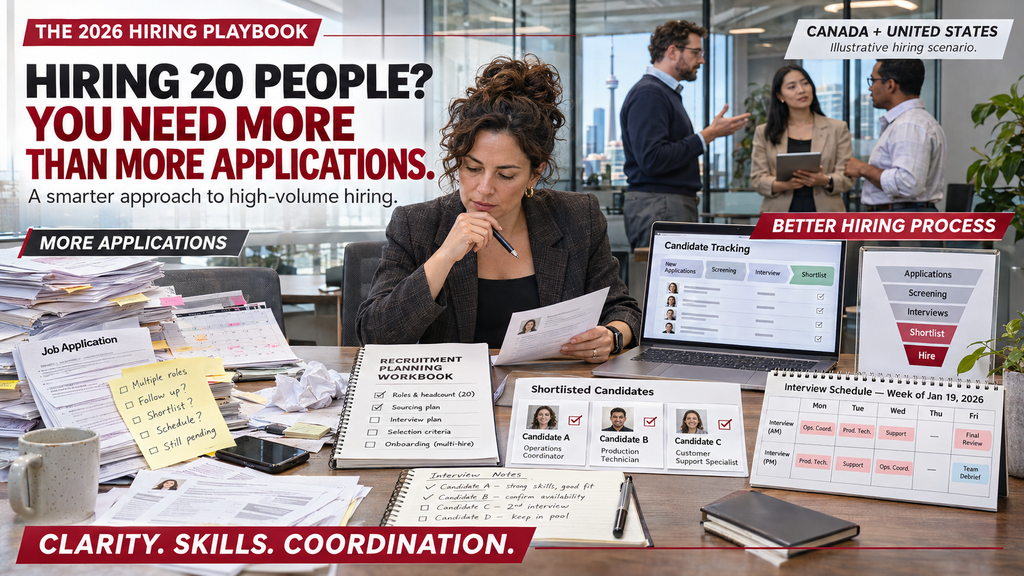
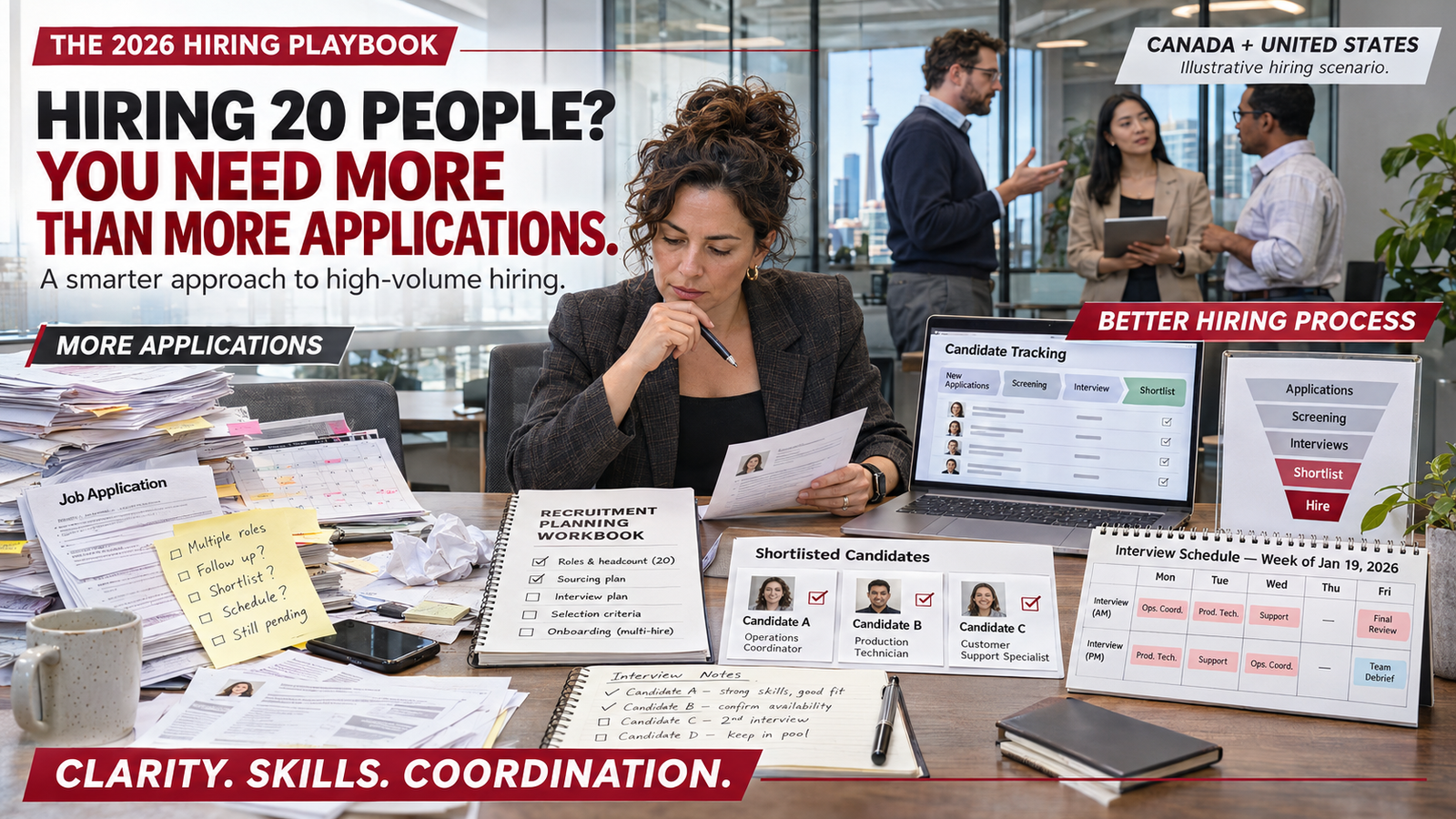
High-volume hiring in 2026 has a surprising problem: finding more applicants doesn’t necessarily mean finding more qualified employees. A business can receive hundreds of applications, spend weeks reviewing résumés, and still struggle to fill essential positions.
Meanwhile, qualified candidates may lose interest because the process is confusing, slow, or unclear.
Imagine a growing company that needs 20 new employees before opening another location.
The hiring manager publishes several job advertisements. Applications begin arriving, but some candidates lack required qualifications, others have incompatible schedules, and promising applicants accept different offers before interviews can be arranged.
The company has plenty of applications—but not enough confirmed hires.
What if the real problem isn’t candidate volume, but how the hiring process is designed?
Recent recruitment research suggests that employers need to pay more attention to applicant quality, verification, communication, and structured hiring decisions.
In this guide, we’ll explore a practical 30-day hiring framework, realistic recruitment metrics, a reusable interview scorecard, and ways both employers and job seekers can improve the process.
You’ll also learn when working with a recruitment partner may be worth considering.
What Is High-Volume Hiring?
High-volume hiring, sometimes called bulk hiring or mass recruitment, involves recruiting multiple employees within a defined period.
For example, organizations may need additional people when:
- A business opens a new location.
- A manufacturer expands production.
- A retailer prepares for seasonal demand.
- A hotel or restaurant group increases staffing.
- A healthcare organization adds capacity.
- A logistics company extends operating hours.
- A technology company expands a customer support operation.
The number of employees involved varies. Hiring 10 people can be a major project for a small business, while a national employer may routinely recruit hundreds.
Therefore, high-volume hiring is better understood as a coordination challenge than as one fixed hiring number.
Bulk Hiring vs. Traditional Recruitment
| Factor | Traditional recruitment | High-volume recruitment |
|---|---|---|
| Hiring demand | One or a few positions | Multiple positions or repeated openings |
| Planning | Individual vacancy | Coordinated workforce plan |
| Candidate screening | Often handled role by role | Shared criteria for similar roles |
| Interviews | Individually arranged | Structured interview blocks |
| Communication | Individual follow-ups | Consistent, organized updates |
| Onboarding | One employee at a time | Multiple arrivals or planned cohorts |
| Success measure | Filling an individual vacancy | Qualified starts, readiness and retention |
Neither method is automatically better.
However, recruiting many people using a completely unstructured individual-hire process can create unnecessary administrative work.
The goal is to build a process that remains fair, practical and responsive as hiring demand increases.
The 2026 Hiring Problem: Too Many Applicants, Not Enough Suitable Matches
The recruitment market is experiencing an important contradiction.
Employers want qualified candidates. Job seekers want genuine opportunities. Yet connecting the two sides remains difficult.
According to iHire’s State of Online Recruiting 2026, 55.7% of the surveyed U.S. employers identified receiving too many unqualified applicants as a significant online recruitment challenge.
In addition, 51.6% reported problems with candidates becoming unresponsive.
The research surveyed 318 employers across 57 U.S. industries in July and August 2026.
These findings represent the experiences of participating employers, not all organizations in North America.
Nevertheless, they reveal two operational problems:
Problem 1: Candidate quantity does not guarantee candidate suitability.
Problem 2: Interested candidates do not necessarily remain available throughout a slow recruitment process.
LinkedIn’s 2026 Future of Talent Report also describes a shift toward better workforce planning, stronger hiring signals, and measuring outcomes beyond the initial hire.
For employers, the practical lesson is clear.
Stop optimizing only for applications. Start optimizing for qualified people who can successfully begin and perform the work.
A Realistic Scenario: Your Business Needs 20 Employees in 30 Days
Let’s examine an illustrative example.
A Canadian business plans to expand its distribution operations.
It needs 20 employees across several operational roles, including warehouse associates, inventory coordinators, and shift-support staff.
The planned start date is approximately one month away.
However, the organization has limited recruiting capacity.
Instead of immediately publishing 20 individual advertisements, management begins by defining the workforce requirement.
Example: The Hiring Brief
| Planning question | Illustrative answer |
|---|---|
| Total hiring target | 20 employees |
| Location | One Canadian operating location |
| Role groups | Warehouse, inventory and shift support |
| Employment arrangement | Full-time, with specified shifts |
| Target start | Within a 30-day planning window |
| Critical requirements | Relevant work eligibility, role-specific safety and availability requirements |
| Preferred qualifications | Previous inventory systems or related experience |
| Interview approach | Structured, job-related interviews |
| Onboarding | Planned orientation groups |
All scenario details are fictional. The 30-day period is a planning example, not a claim that 20 positions can always be filled within 30 days.
Notice that this brief clarifies much more than the number of vacancies.
It identifies the actual operational needs that recruitment must satisfy.
For example, an employee who is otherwise qualified but unavailable for the required shift may not meet that particular role’s scheduling needs.
Similarly, certain jobs require professional licences or safety qualifications that cannot simply be replaced with general experience.
Consequently, employers should separate essential requirements from preferences before screening begins.
For a detailed preparation checklist, read our earlier article, Before You Post Another Job: A Smarter Hiring Checklist.
Although that guide uses Vancouver examples, its planning principles are useful for employers in other locations as well.
The 30-Day High-Volume Hiring Playbook
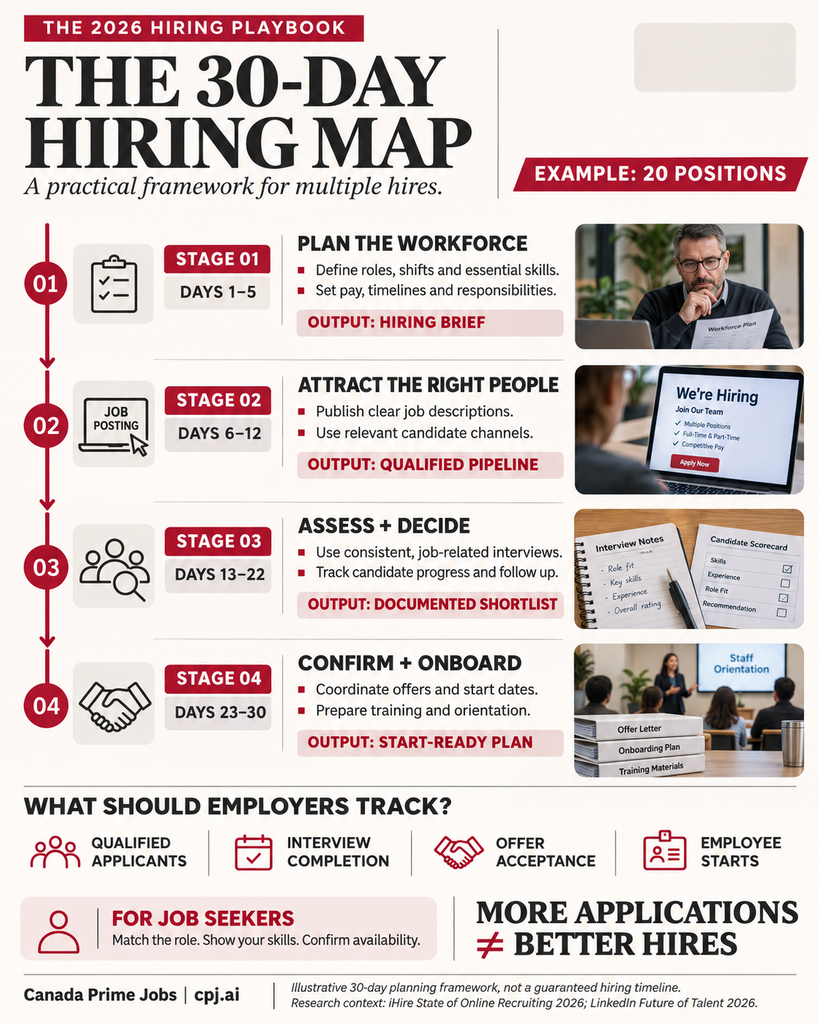
A good bulk hiring strategy should create a clear sequence between defining the need, attracting candidates, evaluating qualifications and preparing employees to start.
The following framework can be adapted for different company sizes and industries.
It is not a guaranteed recruitment timetable. Specialized, regulated or highly competitive roles may require significantly longer.
Days 1–5: Build the Workforce Plan
Before advertising, confirm the actual hiring requirement.
Identify how many people are needed, what work each group will perform, and which positions must be filled first.
Then separate qualifications into three categories.
Must-have requirements: Genuine legal, professional, safety or operational conditions necessary for the position.
Core capabilities: Skills needed to perform the daily responsibilities.
Preferred qualifications: Experience or tools that may improve suitability but are not essential for every applicant.
Next, confirm the compensation range, workplace location, working arrangement, hours, benefits and realistic start date.
Finally, assign ownership for screening, interviews, decisions and candidate communication.
Deliverable: One approved hiring brief and a consistent assessment plan.
Days 6–12: Reach Relevant Candidates
Once the hiring brief is complete, publish clear job advertisements.
Instead of writing a generic description filled with unnecessary requirements, explain the actual work.
For example:
Less useful advertisement:
“Growing company hiring motivated professionals. Competitive salary. Flexible opportunities. Apply today.”
More useful advertisement:
“Inventory Coordinator — Full-Time
Location: Calgary, Alberta
Responsibilities: Maintain inventory records, investigate discrepancies and coordinate stock updates.
Required: Relevant work authorization, inventory accuracy skills and availability for the advertised schedule.
Preferred: Experience with warehouse management software.
Compensation: Published pay range and applicable benefits.
Application process: Application review, structured interview and final decision.”
This is a fictional example. Employers should provide a genuine compensation range and comply with applicable local disclosure rules.
The second advertisement helps candidates decide whether the opportunity matches their qualifications.
In addition, employers can expand their candidate reach through a suitable combination of official career pages, recruitment platforms, employee referrals, industry communities, local workforce resources and recruitment partners.
In Canada, Job Bank offers employers job posting and job-matching resources.
However, the right sourcing mix depends on location, role complexity, budget and the type of workers needed.
Deliverable: Active, accurate vacancy listings and a consistent way to track candidates by role.
Days 13–22: Screen, Interview and Decide
At this stage, speed matters—but so does accuracy.
Start by confirming genuine mandatory qualifications.
Next, assess relevant work capabilities using consistent criteria.
For many roles, short structured interviews can help reduce the inconsistency created when different interviewers ask unrelated questions.
For example, an operations employer could ask:
“Tell us about a time you noticed a work error. What did you do, and what happened afterward?”
This question provides more useful evidence than simply asking whether someone is hardworking.
The Public Service Commission of Canada provides detailed guidance on structured interviews, consistent questions and predetermined evaluation criteria.
Although the guidance was developed for public-service recruitment, several underlying assessment principles are broadly useful.
Use a simple interview scorecard so that candidates are evaluated against job-related evidence.
Finally, keep applicants informed about the next steps.
An unanswered candidate may be weighing several employment options. Clear communication helps both sides make decisions.
Deliverable: A documented shortlist, completed assessments and timely hiring decisions.
Days 23–30: Coordinate Offers and Onboarding
Reaching the offer stage does not mean the hiring project is finished.
Candidates may need time to review compensation, confirm their start date, complete lawful documentation or consider other opportunities.
Therefore, employers should prepare the offer and onboarding process before the final interviews.
Confirm:
- Written job terms and any required documentation.
- Compensation and scheduled hours.
- Start dates and reporting instructions.
- Equipment, workplace access and training arrangements.
- Any legally required checks or professional credential verification.
In addition, identify which manager will support each new employee during their first days.
For group hiring, planned onboarding cohorts may make orientation easier to coordinate.
However, each employee should still receive the information and support needed for their particular role.
Deliverable: Accepted offers, confirmed start arrangements and an onboarding plan.
The Recruitment Funnel: Measure More Than Application Volume
A common mistake in high-volume recruitment is reporting success based primarily on how many résumés have arrived.
For example, an advertisement receiving 500 applications might appear successful.
But what if most applicants do not meet genuine role requirements, the employer cannot contact shortlisted candidates, or accepted offers do not lead to actual starts?
A more useful system tracks progress through the hiring process.
High-Volume Hiring Metrics That Actually Matter
| Stage | What to measure | Why it matters |
|---|---|---|
| Applications | Relevant and complete applications | Shows whether the sourcing strategy reaches the intended audience |
| Initial screening | Candidates meeting essential requirements | Measures application relevance |
| Assessment | Candidates demonstrating required capabilities | Supports evidence-based selection |
| Interview | Attendance and completion | Identifies process friction |
| Offer | Offer acceptance rate | Reveals candidate interest and offer competitiveness |
| Start date | Confirmed employee starts | Measures whether hiring plans become actual staffing |
| Early employment | Retention and readiness | Checks whether recruitment outcomes remain useful |
The numbers should be interpreted together.
For instance, if many people complete interviews but few accept offers, the employer should investigate compensation, scheduling, communication and workplace expectations.
Conversely, if very few candidates meet genuine essential qualifications, the advertisement or sourcing channel may need adjustment.
The best recruitment funnel is not necessarily the one with the most applications. It’s the one that helps employers make suitable, fair and sustainable hiring decisions.
A Simple Interview Scorecard Employers Can Reuse
An interview scorecard makes candidate evaluation more consistent.
Rather than making a decision based on general impressions, employers identify specific evidence related to the role.
Here is a simple example.
| Assessment area | Evidence to look for | Evaluation |
|---|---|---|
| Relevant experience | Examples of comparable work | Needs development / Meets requirements / Strong evidence |
| Problem-solving | A relevant challenge and response | Needs development / Meets requirements / Strong evidence |
| Communication | Clear, job-relevant explanation | Needs development / Meets requirements / Strong evidence |
| Work organization | Ability to prioritize relevant tasks | Needs development / Meets requirements / Strong evidence |
Illustrative scorecard only. Real assessments should be designed for the position, consistently applied, appropriately documented and reviewed for accessibility and fairness.
Certain requirements, such as a mandatory professional licence, should be checked separately as eligibility conditions rather than converted into an arbitrary numerical score.
In addition, interviewers should record the evidence supporting their judgments.
This becomes especially useful when several managers are interviewing candidates for similar positions.
What About AI-Powered Screening?
AI tools may assist with administrative activities such as organizing applications, preparing communications or identifying information that requires review.
However, automated systems can also introduce errors and unfair outcomes.
Therefore, employers should review the accuracy, privacy implications, accessibility and fairness of any tools used in hiring.
Human oversight and applicable legal obligations remain important.
The U.S. Equal Employment Opportunity Commission offers guidance on nondiscriminatory recruitment and hiring.
Canadian employers should also review relevant federal or provincial requirements, including guidance on avoiding barriers in employment assessments.
What Job Seekers Should Know About Bulk Hiring
High-volume hiring is not only an employer challenge.
For job seekers, understanding the process can make it easier to decide which opportunities are worth pursuing.
Imagine a retailer opening several new locations.
The employer may be recruiting sales associates, inventory staff, supervisors and customer service professionals at the same time.
Although these positions belong to one hiring campaign, their qualifications and responsibilities may differ considerably.
Therefore, applicants should not assume that one generic résumé is equally suitable for every opening.
How to Stand Out in a High-Volume Recruitment Process
1. Apply for the right position.
Read the actual responsibilities and confirm that you meet genuine mandatory requirements.
2. Show relevant experience quickly.
Use clear descriptions of practical skills, including transferable experience from previous work, education or volunteering.
3. Confirm your availability accurately.
When a role has specific shifts, locations or start dates, give accurate information about your availability.
4. Prepare one strong work example.
Think of a time you solved a problem, supported a customer, organized work or delivered a result.
5. Respond promptly—but verify the employer.
Check official recruitment channels and avoid sharing sensitive information with unverified contacts.
For a practical guide to fraudulent recruitment messages, read Fake Job Postings in 2026: 9 Red Flags and a 5-Minute Verification Guide.
Don’t Overlook Transferable Skills
A candidate with experience in retail may have relevant customer communication, cash-handling, scheduling or inventory skills.
Similarly, someone moving from hospitality to office administration may have useful experience in coordination, problem-solving and handling enquiries.
Employers should evaluate these capabilities when they are relevant to the job instead of requiring identical job titles unnecessarily.
If you’re considering a career transition, our guide, Will AI Replace Your Job by 2030?, explores changing skills and career opportunities across North America.
When Should an Employer Consider a Recruitment Partner?
Not every organization needs outside recruitment support.
A company hiring one person with an experienced internal recruiter may already have everything it needs.
However, a recruitment partner may be worth considering when an employer faces several simultaneous hiring requirements.
Examples include multi-location expansion, repeated seasonal recruitment, multiple job families, limited internal HR capacity or a need for coordinated candidate assessments.
A useful recruitment partner should help clarify the hiring requirement—not merely promise a larger number of résumés.
What to Ask Before Selecting a Recruitment Partner
| Question | Why it matters |
|---|---|
| Which roles and locations can you support? | Confirms service coverage |
| How are candidates identified and assessed? | Clarifies the evaluation process |
| Can you distinguish mandatory from preferred skills? | Reduces unsuitable referrals |
| How will candidate communication be managed? | Helps prevent avoidable delays |
| What happens after a candidate is selected? | Clarifies onboarding or follow-up support |
| How are fees, timelines and responsibilities defined? | Sets transparent expectations |
These questions are useful whether you’re exploring a recruitment agency, a hiring platform or a combination of internal and external recruitment resources.
How Canada Prime Jobs Can Fit Into a Multi-Hire Recruitment Strategy
For Canadian employers considering additional recruitment support, Canada Prime Jobs (CPJ) presents several services relevant to a structured hiring process.
According to CPJ’s published service information, these include:
Candidate verification: Identity, credentials and experience checks intended to help employers make more informed decisions.
Skills assessment: Evaluation of relevant competencies to support matching candidates with job requirements.
Training and development: Job-readiness and skill-building resources that can support candidate preparation.
Post-hiring support: Follow-up activities intended to support a better long-term fit.
CPJ also describes an employer-facing hiring system where participating employers can review candidate profiles, send hiring invitations and coordinate interviews.
These services may be relevant when a company is planning several hires and wants to discuss a more coordinated recruitment approach.
However, the exact service scope, available candidate supply, geographic coverage, fees and project timeline should be confirmed with CPJ before making commitments.
Planning 10, 20 or More Hires? Start With a Hiring Brief
If your company is preparing a multi-position recruitment campaign, begin with the following information:
| Information | What to provide |
|---|---|
| Company and industry | Your business and operational context |
| Hiring locations | City, province/state and work arrangement |
| Positions required | Titles and approximate number of vacancies |
| Essential qualifications | Licences, job-related skills and other mandatory requirements |
| Compensation | Pay range and key employment terms |
| Planned start dates | Expected hiring and onboarding timeline |
| Recruitment challenges | Candidate sourcing, screening, scheduling or retention concerns |
With this information, an employer can have a more productive conversation about whether CPJ’s recruitment services fit the hiring project.
For Canadian recruitment needs, employers can contact Canada Prime Jobs or email info@cpj.ai.
You can also explore the CPJ employer hiring portal and review how the CPJ hiring process is described.
For U.S.-based hiring projects, ask CPJ to confirm the relevant geographic and operational support before proceeding.
The objective is not simply to attract more applicants. It’s to build a recruitment process around the people, skills and operational needs that matter to your business.
Five Common High-Volume Hiring Mistakes
Even experienced employers can make mistakes when recruitment volume increases.
Mistake 1: Publishing Vague Job Descriptions
An advertisement that does not explain duties, schedules or required qualifications attracts avoidable uncertainty.
Better approach: Write specific, transparent and job-related requirements.
Mistake 2: Treating Every Qualification as Mandatory
Long lists of unnecessary requirements can discourage applicants who may be capable of performing the work.
Better approach: Separate essential conditions from preferred experience.
Mistake 3: Using Inconsistent Interviews
When interviewers assess candidates using unrelated questions, comparing their evidence becomes difficult.
Better approach: Use structured, job-relevant assessment criteria.
Mistake 4: Failing to Communicate
Candidates may become unavailable while waiting for decisions.
Better approach: Establish realistic communication intervals and provide timely updates.
Mistake 5: Ignoring the First 30 Days of Employment
A signed offer alone does not establish that the staffing need has been solved.
Better approach: Plan onboarding, manager support and early feedback before employees arrive.
Frequently Asked Questions About High-Volume Hiring
What is high-volume hiring?
High-volume hiring is a coordinated recruitment process for multiple employees within a defined period. It may involve new locations, seasonal demand, growing operations or repeated vacancies.
Is bulk hiring the same as mass recruitment?
The terms are frequently used interchangeably. However, the scale and process can vary significantly depending on the employer, industry and hiring requirements.
Can a company hire 20 employees in 30 days?
It may be possible in some circumstances, but there is no universal timeline. Outcomes depend on candidate availability, qualifications, location, compensation, recruitment capacity, legal requirements and onboarding arrangements.
How can small businesses manage bulk recruitment?
Start with a hiring brief, group similar positions, publish clear requirements, use consistent screening and interviews, and assign responsibility for candidate communication. External support may also be useful.
Is high-volume hiring only for entry-level jobs?
No. Employers may recruit multiple employees across operational, administrative, technical, healthcare, professional and management roles. More specialized positions often require longer recruitment timelines.
How do job seekers prepare for a bulk hiring event?
Review the roles individually, confirm mandatory qualifications, prepare a relevant résumé, demonstrate practical skills and verify the employer through official channels.
Can Canada Prime Jobs help employers with multiple vacancies?
CPJ publishes information about candidate verification, assessments, training and hiring support. Employers planning several hires can contact CPJ to discuss the project’s roles, locations, candidate needs and available service scope. Capacity and timelines should be confirmed directly.
Final Thoughts: Hiring More People Requires a Better System
In 2026, recruiting multiple employees is not simply about posting more advertisements.
Employers need a clear understanding of workforce requirements, candidate qualifications, interview processes, communication and onboarding.
At the same time, applicants benefit when employers explain opportunities honestly and assess relevant skills consistently.
The strongest recruitment process is one in which both sides can make informed decisions.
Better hiring starts with better planning—not just more applications.
If your business is preparing to hire multiple employees in Canada, contact Canada Prime Jobs to discuss your requirements and explore the recruitment support available.
If you’re looking for work, you can browse opportunities on CPJ and review current listings relevant to your experience.
Sources and Research References
Research reviewed November 2026. Survey statistics are not population-wide estimates, and the 30-day plan in this article is an illustrative operational framework.
- iHire — State of Online Recruiting 2026 — U.S. employer and job seeker research, September 2026.
- LinkedIn — Future of Talent Report 2026 — Recruitment strategy, workforce planning and talent outcomes.
- LinkedIn — 2026 Talent Research — Recruiting challenges and skills-based hiring.
- Government of Canada Job Bank — Recruit and Hire — Employer recruitment and job-matching resources.
- Public Service Commission of Canada — Structured Interview Guidance — Consistent, job-related interview assessment.
- U.S. EEOC — Recruiting, Hiring and Promoting Employees — U.S. employment nondiscrimination guidance.
- Canada Prime Jobs — About Us — Published information about CPJ services and recruitment support.
- Canada Prime Jobs — The Complete Hiring Process — CPJ’s published employer hiring workflow.
This article is for general information and planning. Employment, licensing, privacy, immigration and recruiting obligations vary by province, state, industry and employer.