

Headhunting vs Recruitment in 2026: Why Companies Hire and Downsize at the Same Time
A Practical Workforce Strategy Guide for Employers and Professionals in Canada and the United States | November 2026
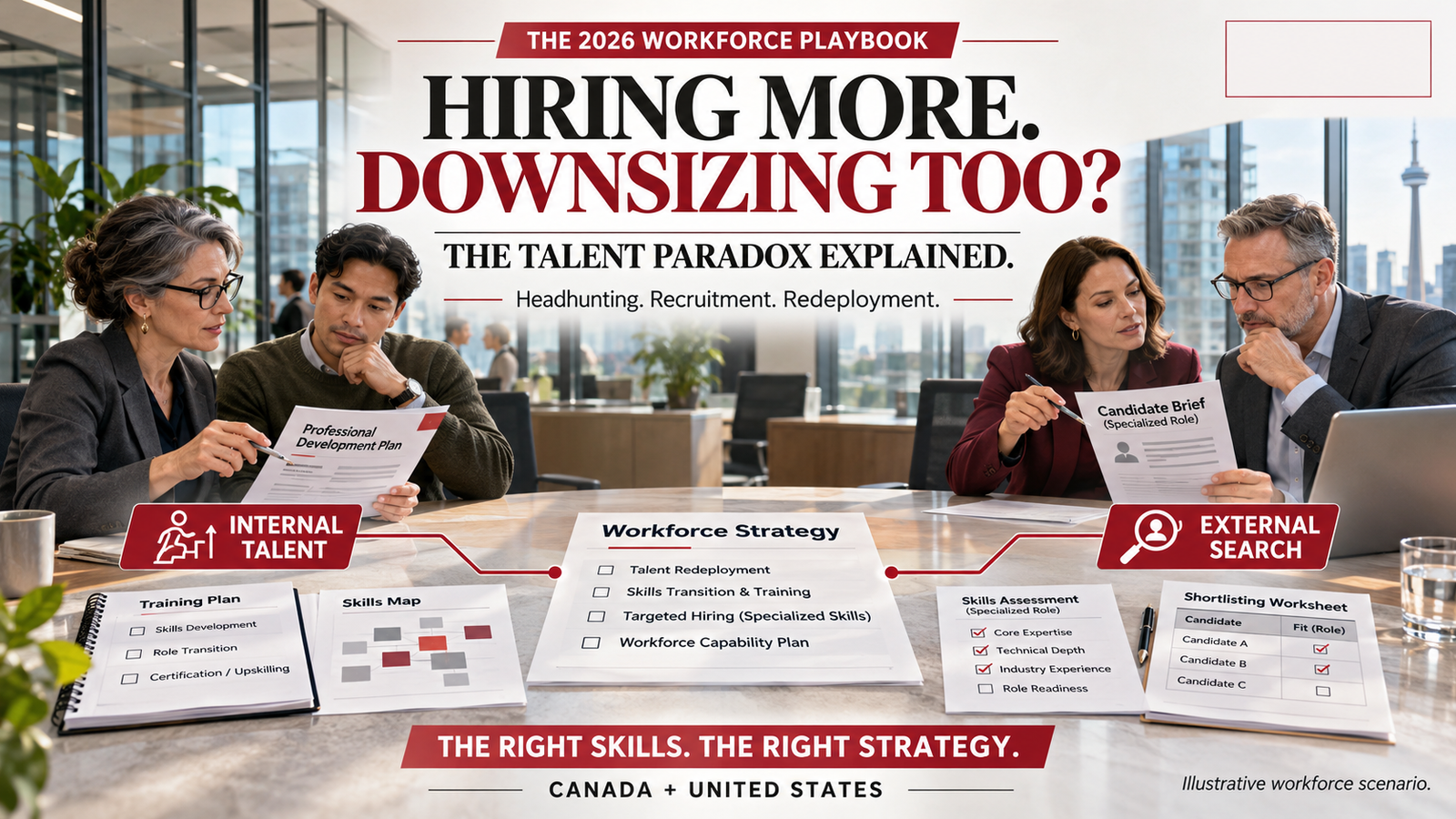
Headhunting vs recruitment is no longer just a question of how to find candidates. In 2026, the harder question for many employers is whether they should hire externally, develop existing employees, move people into different roles or redesign their workforce altogether.
Here is a situation that may sound contradictory.
A company announces that it is reducing positions in one department. A few weeks later, the same organization advertises new jobs and begins searching for specialized professionals.
Employees are confused. Job seekers wonder whether the company is stable. Hiring managers struggle to explain why some roles are disappearing while others remain difficult to fill.
How can a business have too many employees in one area and not enough qualified people in another?
The answer often involves a mismatch between the work an organization currently performs and the capabilities it needs next.
That does not automatically justify layoffs. Nor does it mean that existing employees cannot learn new skills or move into different positions.
However, it does mean employers need a better decision-making framework.
Recent research underscores the challenge. According to Statistics Canada, 25.2% of Canadian businesses surveyed in the third quarter of 2026 expected recruiting skilled employees to be an obstacle over the following three months.
Meanwhile, LHH’s 2026 research found a significant difference between employer-reported redeployment programs and employee awareness of those opportunities.
Together, these findings raise an important question:
Are companies searching for new talent before fully understanding the talent they already have?
In this guide, we’ll compare headhunting vs recruitment, explain when bulk hiring makes sense, explore employee redeployment and training, and offer a practical framework for navigating workforce restructuring responsibly.
We’ll also explain how a recruitment partner such as Canada Prime Jobs (CPJ) may fit into a broader hiring strategy.
Why Companies Can Be Hiring and Downsizing at the Same Time
Organizations do not always reduce their workforce because every part of the business is shrinking.
Sometimes, the company is changing what it produces, how it serves customers, which technologies it uses or where it operates.
For example, a manufacturer may reduce demand for certain administrative tasks while expanding its equipment-maintenance operations.
A retailer may close one location while opening another.
A healthcare organization may reorganize back-office operations while still needing appropriately qualified clinical staff.
A technology company may reduce investment in one product while recruiting specialists for another.
These are examples of how workforce requirements can change—not evidence that layoffs are necessary or inevitable.
Five Reasons Hiring Needs Change
| Business change | Potential hiring challenge | Decision to investigate |
|---|---|---|
| Technology adoption | Existing tasks change and new capabilities are needed | Retrain, redesign roles or recruit |
| Expansion into new markets | Skills or staffing capacity are missing | Targeted recruitment or bulk hiring |
| Organizational restructuring | Roles overlap or move between departments | Internal mobility and redeployment |
| Specialized leadership vacancy | Few suitable candidates are actively applying | Headhunting or executive search |
| Temporary demand pressure | Staffing requirements fluctuate | Scheduling, work-sharing or alternative staffing arrangements |
Before selecting a solution, employers should investigate whether the issue is a genuine workforce shortage, a skills gap, a process problem or a change in business demand.
This distinction can prevent unnecessary hiring activity—and help organizations consider alternatives to job losses.
What Does the 2026 Research Actually Show?
The labour market is not experiencing the same conditions in every occupation, industry or location.
Therefore, employers should avoid assuming that all skills are equally scarce.
Canada’s Skilled-Recruitment Challenge
Statistics Canada’s third-quarter 2026 business survey found that:
- 25.2% of businesses expected difficulty recruiting skilled employees over the following three months.
- 17.2% expected labour-force shortages.
- 15.5% expected difficulty retaining skilled employees.
These percentages refer to specific expected obstacles among surveyed Canadian businesses—not to the proportion of unfilled positions.
The findings suggest that hiring challenges remain important, even though broader labour-market conditions have changed since the peak vacancy levels of 2022.
As a result, recruitment strategies should reflect the actual occupation and local market rather than a general claim that no workers are available.
The Hidden Redeployment Problem
A multinational 2026 study by LHH surveyed 3,000 HR leaders and more than 8,000 employees across seven countries, including Canada and the United States.
Among participating HR leaders, 77% said their organization offered targeted redeployment or mobility programs.
However, only 19% of surveyed employees said they recognized or experienced such programs.
The figures come from different respondent groups and are not Canada-specific or U.S.-specific estimates.
Nevertheless, they illustrate a practical issue: having a mobility program is not the same as making it visible and accessible to employees.
Before a company searches externally, it may be worth asking whether qualified employees already exist elsewhere in the organization.
Recruitment Is Becoming a Workforce Strategy Function
LinkedIn’s Future of Talent Report 2026 describes a broader shift from traditional recruiting toward what it calls talent orchestration.
The central idea is that employers should connect business needs with recruitment, internal mobility, skills development and workforce planning.
This does not mean every employer requires an expensive new system.
Instead, it encourages a more useful question:
What is the best way to obtain the capability our business needs?
Sometimes the answer is headhunting.
At other times, the answer may be training an existing employee.
Headhunting vs Recruitment: What’s the Difference?
Traditional recruitment and headhunting both aim to connect employers with suitable candidates.
However, they generally approach the talent market differently.
Headhunting vs Recruitment Comparison
| Factor | General recruitment | Headhunting / targeted search |
|---|---|---|
| Typical purpose | Fill an advertised vacancy | Identify specific, often difficult-to-reach talent |
| Candidate audience | Often active applicants | Active and passive professionals |
| Sourcing approach | Job ads, referrals, candidate databases | Research, networks and direct outreach |
| Role requirements | Broad range of job categories | Often specialized, senior or scarce-skill roles |
| Candidate engagement | Standard application and screening process | More individualized and confidential discussions |
| Main strength | Organized access to interested candidates | Reaching people unlikely to apply independently |
| Main limitation | May miss professionals not actively searching | Requires careful research, relationship-building and role clarity |
These are typical differences, not universal rules. Many recruitment firms combine both methods.
When General Recruitment Is the Better Choice
General recruitment can be effective when a vacancy is clearly defined and qualified applicants are reasonably accessible.
For instance, a company opening several retail locations may need employees across sales, customer service and inventory roles.
The employer can publish transparent job advertisements, use relevant recruiting channels and evaluate applicants against consistent criteria.
In this situation, individually headhunting every candidate might create unnecessary work.
Instead, a well-organized high-volume recruitment process may be more appropriate.
For a detailed example, read our 30-Day High-Volume Hiring Playbook.
When Headhunting May Be Worth Considering
Headhunting becomes particularly relevant when a role requires a difficult combination of experience, technical expertise, industry knowledge or leadership capabilities.
Consider a company searching for a senior plant operations director.
The ideal person may already be employed, performing successfully and not actively browsing job advertisements.
A traditional posting might reach some suitable professionals, but targeted sourcing may identify additional candidates.
A thoughtful headhunting process can include:
- Defining the genuine business problem and the capabilities required.
- Researching relevant industries, employers and professional networks.
- Approaching potentially suitable professionals respectfully.
- Explaining the opportunity and its requirements transparently.
- Assessing relevant skills, experience and professional qualifications.
- Coordinating confidential discussions and employer decisions.
However, headhunting does not guarantee that a candidate will accept an offer.
Compensation, professional growth, location, organizational reputation and the actual responsibilities remain important.
The Five-Path Workforce Decision Framework
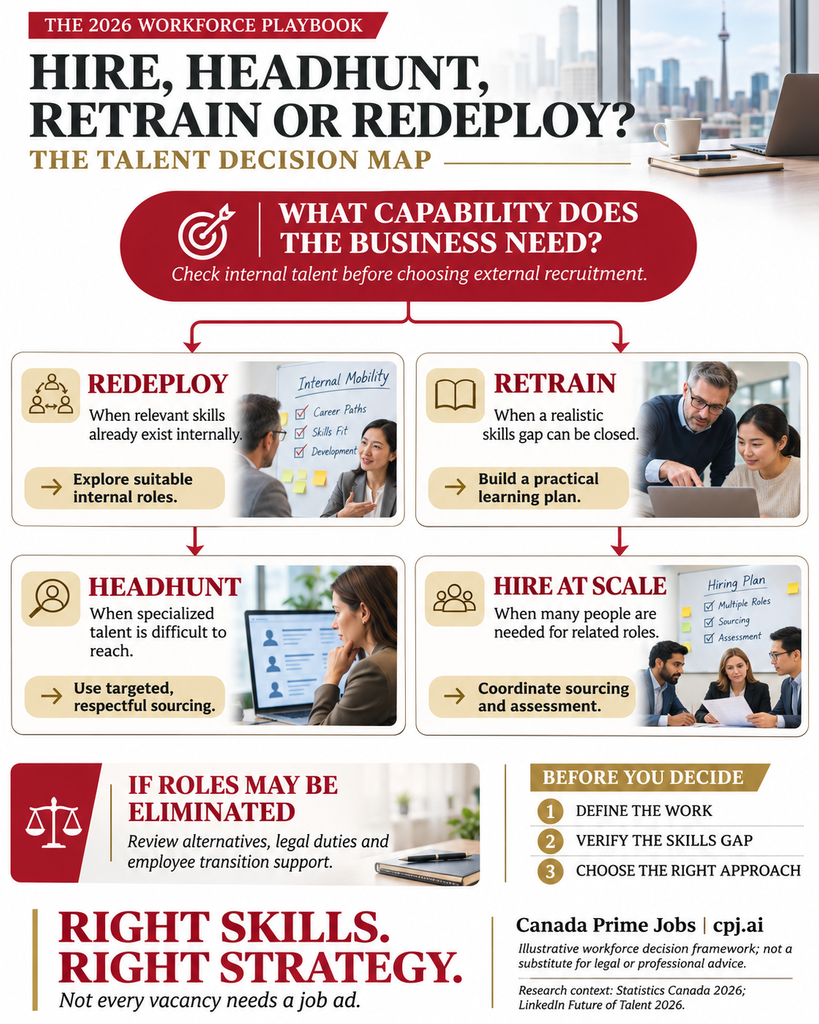
Instead of automatically opening a vacancy, employers can begin by identifying the type of capability gap they face.
The following framework provides five options worth examining.
Path 1: Redeploy Existing Talent
Best considered when: Employees already possess relevant transferable skills, and suitable internal positions exist.
For example, an experienced customer support supervisor may have strong process improvement and team coordination skills.
If the organization needs an operations coordinator, that employee might be a credible candidate for an internal move.
Redeployment is not simply moving someone because a department has fewer vacancies.
It requires an appropriate match between skills, responsibilities, employment conditions and employee interests.
Furthermore, employers should apply fair criteria and provide reasonable support during transitions.
Path 2: Retrain or Upskill Employees
Best considered when: The skill gap can realistically be closed through relevant training.
Imagine a distribution company adopting new warehouse software.
Some employees may already understand inventory operations but lack experience with the new system.
Instead of assuming external recruitment is necessary, management could evaluate whether structured training would build the required capability.
Training may involve technical instruction, supervised practice, mentoring or role-specific assessments.
However, it is not appropriate to assume that short training can replace mandatory professional licences or substantial specialist experience.
In Canada, eligible employers may also investigate the government’s Workforce Retention and Retraining Program, which includes measures intended to support workforce adaptation and help avoid layoffs.
Eligibility and program conditions must be checked directly with the government.
Path 3: Use Headhunting for Scarce Skills
Best considered when: The organization requires specialized expertise that is difficult to obtain through ordinary applications or internal development within the relevant timeframe.
Examples might include a senior cybersecurity leader, a specialized industrial engineer, a technical director or an experienced operations executive.
The employer should first define the capabilities that genuinely distinguish the position.
Afterward, targeted search can focus on identifying suitable professionals and engaging them in informed discussions.
A useful search process should evaluate more than impressive job titles.
Instead, it should examine relevant experience, evidence of capability, leadership responsibilities and role requirements.
Path 4: Use Bulk Recruitment for Multiple Positions
Best considered when: The organization needs several employees across similar or related roles.
For example, a logistics company might be preparing a new distribution facility.
It may need warehouse associates, inventory coordinators, customer support staff and shift supervisors.
A coordinated hiring project can organize sourcing, interviews, candidate communication and start dates.
However, employers should not apply identical assessments to unrelated occupations.
Role-specific qualifications still matter.
If your organization has recently completed multiple hires, our 90-Day Recruitment and Onboarding Guide explains how to connect accepted offers with employee preparation and development.
Path 5: Manage Necessary Workforce Transitions Responsibly
Best considered when: Following genuine business review and consideration of alternatives, some positions may still need to be eliminated.
Workforce restructuring is not just a staffing calculation.
It affects people’s income, career plans, wellbeing and confidence in their employer.
Organizations should consider available alternatives, apply lawful and nondiscriminatory criteria, communicate clearly and provide appropriate support.
Where available, specialized outplacement services may help affected employees prepare for their next opportunities.
Importantly, redeployment, training and external career-transition support are different services.
An employer should define which are needed rather than assuming one recruitment provider automatically delivers all three.
Before workforce reductions, seek qualified employment-law and HR guidance for the applicable jurisdiction.
A Practical Example: One Company, Three Different Talent Problems
Consider a fictional North American manufacturer adapting its operations.
The organization is planning to introduce new equipment, expand distribution and reorganize certain administrative activities.
Management identifies three separate workforce needs.
| Business challenge | Example requirement | Approach to evaluate |
|---|---|---|
| New technical equipment | Two specialized maintenance engineers | Internal assessment, training feasibility, then targeted search if needed |
| Expanding distribution | Fifteen operations employees | Coordinated high-volume recruitment |
| Changing administrative work | Existing employees whose duties are being redesigned | Skills assessment, redeployment and retraining options |
This scenario does not establish that any employee must be laid off.
Instead, it illustrates why a single recruitment method may not solve all workforce problems.
The organization could need targeted external search in one department, multiple hires in another, and an internal skills-development plan elsewhere.
The key is to evaluate those decisions together.
The Questions Leadership Should Ask
Before approving additional external recruitment or workforce reductions, the leadership team should review:
- What work must be completed over the next 6–12 months?
- Which capabilities already exist within the organization?
- Which skills could employees realistically develop?
- Which roles genuinely require external expertise?
- What support and legal review would be needed for any proposed workforce reductions?
A coordinated workforce strategy is more defensible when decisions follow documented needs rather than assumptions.
The 15-Minute Talent Strategy Diagnostic
Employers can use the following worksheet before launching a difficult hiring project.
| Question | If the answer is YES | Possible next step |
|---|---|---|
| Can an existing employee perform the role with appropriate support? | Internal talent is available | Explore redeployment |
| Can the required skill be developed within a realistic timeframe? | The gap is trainable | Design a training plan |
| Is the role specialized and difficult to source? | Ordinary recruitment may have limited reach | Explore headhunting |
| Are multiple people needed for similar roles? | The requirement is repeatable | Plan bulk recruitment |
| Are positions being eliminated or significantly changed? | Employees may be affected | Review alternatives, legal duties and transition support |
These questions are not a substitute for professional workforce planning.
However, they can help employers separate very different problems before committing resources.
Build a Useful Decision Record
For each position or job family, record the business need, essential skills, available internal capabilities, chosen approach and decision owner.
A simple example:
| Role group | Capability gap | Proposed approach | Decision owner |
|---|---|---|---|
| Technical maintenance | Specialized equipment experience | Evaluate internal skills, then targeted sourcing | Operations + HR |
| Customer operations | Increased staffing demand | Bulk recruitment | HR + Department manager |
| Administrative coordination | Duties changing | Internal mobility assessment | HR + Leadership |
All examples are fictional.
The purpose is to make workforce decisions more understandable, consistent and reviewable.
Why Restructuring Requires More Than a Recruitment Plan
An organization may have legitimate business reasons to review staffing levels.
However, employment decisions must still be made lawfully and responsibly.
Canadian Employers: Check the Applicable Employment Rules
Canada has different employment standards depending on whether an employer is federally or provincially regulated.
For example, federal rules can impose specific obligations on covered employers when a group termination involves 50 or more employees at one industrial establishment within a four-week period.
See the Government of Canada’s official termination and group termination guidance.
These federal thresholds should not be assumed to apply identically to provincially regulated workplaces.
Employers should obtain advice based on their specific jurisdiction, workforce and circumstances.
U.S. Employers: Consider WARN and Fair Selection Criteria
In the United States, the federal Worker Adjustment and Retraining Notification Act (WARN) can require advance notice of certain plant closings and mass layoffs by covered employers.
State-level requirements may also apply.
The U.S. Department of Labor provides an overview of federal WARN requirements.
Furthermore, the Equal Employment Opportunity Commission explains that workforce-reduction decisions must not be based on unlawful discrimination or retaliation.
A recruitment agency is not a substitute for legal counsel or qualified employment-transition specialists.
Organizations should treat those responsibilities separately and coordinate them appropriately.
What Employees and Job Seekers Can Learn From Workforce Changes
When a company restructures, the experience can be confusing for existing employees and applicants.
However, workforce changes do not necessarily mean every occupation in an affected industry is disappearing.
Sometimes, the organization is shifting resources toward different skills or business activities.
That makes it useful to understand how your capabilities can transfer between roles.
Three Practical Career Questions
1. Which skills have I demonstrated through real work?
Consider problem-solving, customer communication, technical abilities, coordination, project delivery or leadership.
Use examples rather than broad descriptions.
2. Where else could those skills be useful?
An employee leaving one department may have relevant capabilities for another role, a different industry or a new employer.
Compare actual responsibilities and mandatory qualifications before applying.
3. What additional skill would expand my options?
A short course may be useful for software familiarity or a specific workplace procedure.
However, some career transitions require more extensive education, certification or supervised experience.
For insights into changing occupations, read Will AI Replace Your Job by 2030?.
When applying externally, also review the opportunity carefully. Our guide to identifying fake job postings explains how to verify employers and avoid suspicious recruitment messages.
Your career potential should not be defined only by your last job title.
When Should an Employer Work With an External Recruitment Partner?
Not every organization needs outside recruitment services.
A company with a capable internal HR team, an established candidate pipeline and straightforward hiring requirements may be able to manage the process independently.
However, external support may be worth exploring when:
- Multiple roles need to be recruited simultaneously.
- Specialized or difficult-to-find capabilities are required.
- Internal HR capacity is limited.
- Candidate screening needs more consistent evidence.
- Employers want to explore skills assessment or training support.
- Recruitment processes involve several locations or job families.
The value of a recruitment partner should be measured by the responsibilities it can actually perform.
What Benefits Should Employers Look For?
Clearer candidate requirements: A useful partner should help translate business needs into understandable qualifications.
More relevant sourcing: Recruitment efforts should focus on candidates who are genuinely suitable for the role.
Structured assessment: Job-related evidence can support more consistent decisions.
Better coordination: The employer should understand the status of applications, interviews and hiring decisions.
Development support: Where available, relevant training and post-hiring resources may help address identified skills gaps.
None of these benefits should be treated as a guaranteed outcome.
A prospective partner should explain its services, limitations, responsibilities and commercial terms before the project starts.
Where Canada Prime Jobs Can Fit Into Complex Hiring Projects
Canada Prime Jobs (CPJ) is a Canadian recruitment and career-development platform that publishes information about candidate matching, verification, skills assessments, training and post-hiring support.
These capabilities are relevant to several of the challenges discussed in this guide.
Candidate Sourcing and Hiring Coordination
CPJ describes an employer-facing recruitment workflow that allows participating employers to review candidate profiles, examine available information and coordinate hiring invitations.
Learn more through The Complete Hiring Process on CPJ.
For employers managing multiple vacancies, this provides a starting point for discussing how candidate information and recruitment activity might be organized.
Candidate Verification
CPJ describes processes for verifying relevant identity, educational and work-history information.
These activities can support employers who need to review candidate credentials before making decisions.
Explore CPJ Candidate Verification.
The appropriate checks, candidate permissions, costs and timelines should be clarified for each engagement.
Skills Assessment
CPJ publishes information about general and job-specific assessments intended to help evaluate relevant candidate competencies.
This may be useful when résumés alone do not provide enough evidence of capability.
Read about CPJ Skills Assessment.
Assessments should remain relevant to the position and respect applicable employment and privacy requirements.
Training and Job Readiness
CPJ also describes training programs intended to address identified skills gaps.
These resources may be relevant when employers are considering candidates who have strong transferable experience but need additional development.
Program availability, delivery arrangements and workplace-specific training needs should be confirmed directly.
Post-Hiring Support
CPJ’s published service information includes ongoing career-development and post-hiring support.
That is relevant because successful workforce planning extends beyond making a job offer.
See CPJ About Us and the CPJ FAQ.
Can CPJ Help With Headhunting, Bulk Hiring or Workforce Restructuring?
Employers facing complex recruitment needs can contact CPJ to discuss the project and determine which services may be available.
Examples of needs worth discussing include specialized talent search, multiple vacancies, candidate assessments, training coordination or changes in workforce requirements.
However, the public CPJ pages reviewed do not independently establish dedicated executive-search contracts, a guaranteed high-volume placement capacity, formal outplacement delivery, employment-law representation or full operational coverage across the United States.
These matters should be confirmed with CPJ before making a commercial commitment.
For organizations undergoing restructuring, legal decisions and employee-transition obligations should remain with appropriately qualified parties.
A useful partnership begins with a clear description of the problem—not an unrealistic promise that one provider can solve every workforce challenge.
Planning Specialized or Multiple Hires? Start With This Brief
If you’re responsible for recruiting difficult-to-find professionals, hiring several employees or redesigning a workforce, use this short project brief before contacting a recruitment provider.
| Information | What to prepare |
|---|---|
| Company and industry | Business activity and operating context |
| Hiring geography | Canadian provinces, U.S. states or specific cities |
| Roles required | Job titles and approximate number of vacancies |
| Critical capabilities | Essential skills, licences and experience |
| Internal talent options | Skills already available within the organization |
| Hiring challenge | Scarce talent, limited capacity, multiple vacancies or process issues |
| Desired support | Recruitment, assessments, training or related services |
| Timeframe | Preferred start dates and operational dependencies |
| Compensation | Genuine pay ranges and employment conditions |
| Decision contact | Authorized employer representative |
Discuss Your Hiring Needs With CPJ
Are you searching for specialized talent, expanding a team or looking for a more organized way to recruit multiple employees?
Contact Canada Prime Jobs to discuss your roles, location, skills requirements and intended hiring process.
You can also email info@cpj.ai with the subject:
Specialized Recruitment & Workforce Support Inquiry
Describe the challenge and ask CPJ to confirm its available services, coverage, timelines and terms.
For U.S. projects, confirm the scope of geographic and operational support before proceeding.
Frequently Asked Questions
What is the difference between headhunting and recruitment?
General recruitment commonly uses job advertisements, referrals and applicant screening. Headhunting typically involves proactive identification and direct engagement of professionals with particular skills or experience. Many recruiting providers use both methods.
When should an employer hire a headhunter?
A targeted search may be worth considering when a role is senior, specialized, confidential or difficult to fill through ordinary applications. The employer should compare the approach with internal sourcing and development options.
Why do companies hire and lay off employees at the same time?
Different departments may face different business conditions, staffing levels and skills requirements. However, companies should still evaluate internal mobility and retraining options and follow applicable employment laws.
Is headhunting useful for bulk hiring?
It can be useful for particular specialist or leadership roles within a larger hiring project. However, coordinated general recruitment may be more suitable for repeated positions with accessible candidate pools.
Can redeployment prevent layoffs?
In some situations, moving employees into suitable internal roles can help avoid job losses. Successful redeployment depends on available positions, relevant skills, employee preferences, appropriate support and applicable legal requirements.
Can employees who have been laid off still be strong candidates?
Yes. A layoff does not automatically indicate poor performance. Recruitment decisions should focus on job-related skills, experience, qualifications and evidence rather than unsupported assumptions about employment history.
Does CPJ offer executive headhunting and outplacement?
The published service pages reviewed describe recruitment, verification, assessment, training and post-hiring support. Dedicated headhunting or outplacement arrangements should be discussed directly with CPJ and confirmed before engagement.
Can CPJ help a company hiring 20 or more employees?
Employers can contact CPJ to discuss their hiring needs and available recruitment services. The number of vacancies, roles, locations, sourcing capacity, commercial terms and timing should be confirmed for each project.
Final Thoughts: The Best Talent Strategy Is Not Always Another Job Advertisement
Organizations across Canada and the United States are navigating changing skills needs, technological developments and shifting business conditions.
Yet difficult workforce decisions should not automatically result in one response.
Some challenges require external recruitment. Others may justify targeted headhunting, internal mobility, structured training or a better-coordinated hiring process.
When workforce reductions are unavoidable, organizations must also consider their legal obligations and the people affected.
For employers, the most useful question is not simply:
“How do we fill this vacancy?”
It is:
“What capability does our business need—and what is the most responsible, effective way to build it?”
That is the starting point for a stronger workforce strategy.
If your organization is planning specialized hiring, multiple vacancies or a review of its recruitment approach, start a conversation with Canada Prime Jobs to explore the services and support available for your particular needs.
Sources and Further Reading
Research reviewed November 2026. Survey findings describe the relevant respondent groups and should not be treated as universal estimates for all employers.
Canadian labour-market research
- Statistics Canada — Business Conditions in Canada, Q3 2026
- Statistics Canada — Analysis on Employee Skills Gaps, Q1 2026
Talent and workforce research
- LinkedIn — Future of Talent Report 2026
- LHH — The Mobility Breakdown: Redeployment and Outplacement Trends, April 2026
Official workforce and employment guidance
- Government of Canada — Workforce Retention and Retraining Program
- Government of Canada — Termination, Layoff and Group Termination
- U.S. Department of Labor — Plant Closings and Layoffs
- U.S. EEOC — Layoff and Reduction-in-Force Guidance
Canada Prime Jobs resources
Educational information only. Employment legislation, privacy requirements, professional licences, restructuring obligations and recruiting arrangements vary by jurisdiction. Seek qualified advice where necessary.



One Response