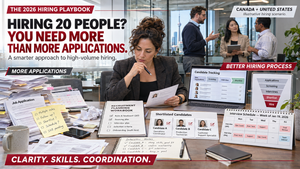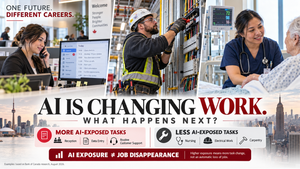

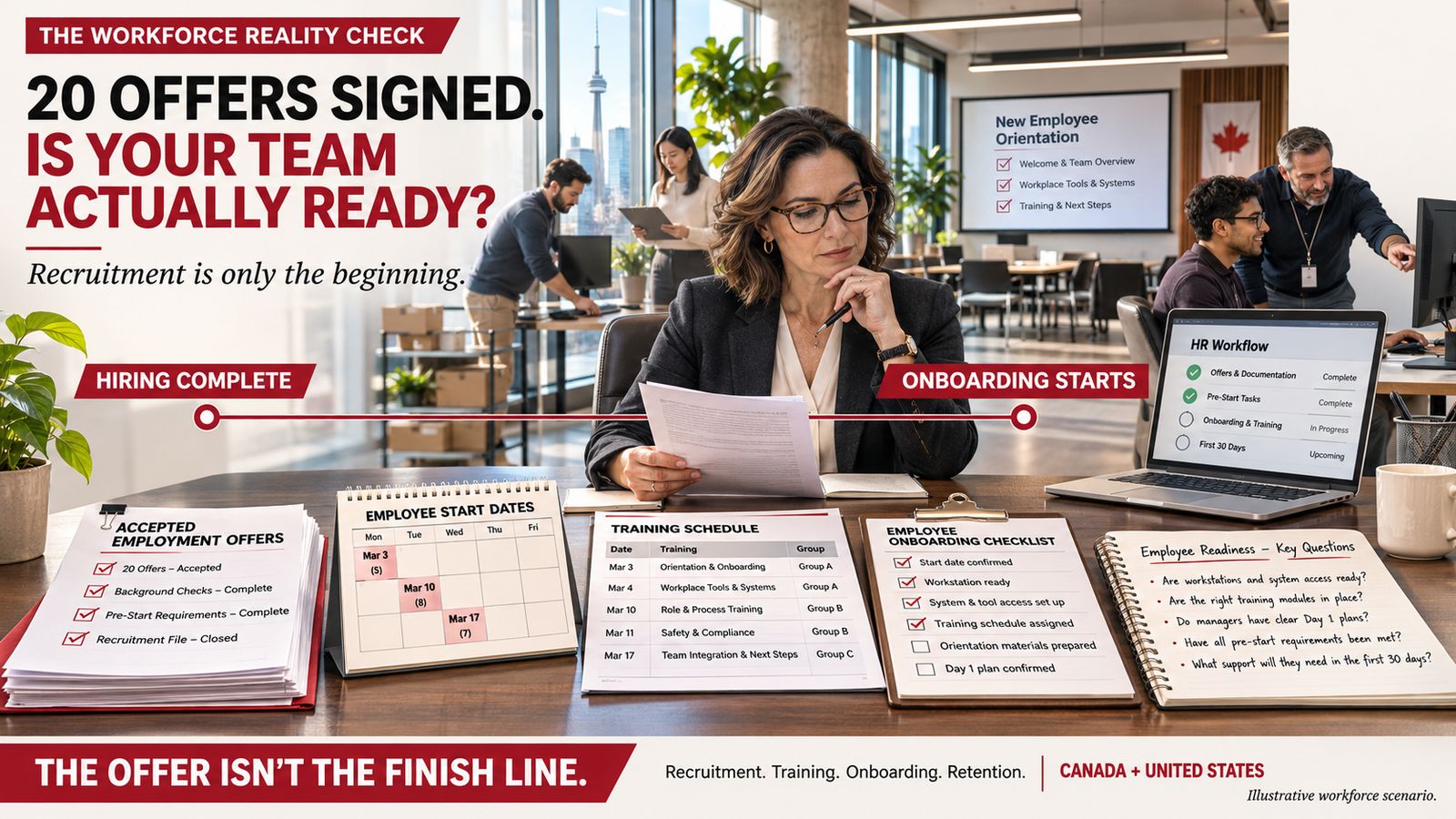
You Hired 20 People. Now What? The 90-Day Recruitment, Onboarding & Training Playbook for 2026
Employer Guide | Canada & United States | Updated November 2026
Recruitment and onboarding are often treated as separate projects. One team works hard to attract candidates, interview applicants and secure accepted offers. Then another team is expected to prepare those people to succeed at work.
But what happens in between?
Imagine a growing company preparing to open a second location.
After weeks of recruiting, the hiring manager finally confirms 20 new employees. The leadership team celebrates. The vacancies appear to be filled, and the expansion is moving forward.
Yet on the first day, several employees are waiting for system access. Some managers have no structured training plan. Others aren’t sure who is responsible for onboarding.
By the end of the first week, the business realizes that hiring 20 people and preparing 20 people to perform their jobs are very different achievements.
This is the challenge that a stronger recruitment and onboarding strategy needs to solve.
And it matters more in 2026 than many employers realize.
According to SHRM’s 2026 Talent Trends Report, 68% of surveyed U.S. HR professionals reported difficulty recruiting full-time employees, while 42% experienced difficulty retaining full-time staff.
Meanwhile, 41% reported training existing employees to help fill difficult roles.
These findings highlight a bigger question for growing businesses:
What if the solution to your staffing problem involves not only finding people, but also preparing, integrating and supporting them?
This guide explains how to build a more connected approach to recruitment, specialized talent search, skills assessment, onboarding and employee development.
You’ll discover a practical 90-day framework, a recruitment strategy comparison, useful readiness metrics and questions to ask a potential hiring partner.
Why Hiring More People Doesn’t Automatically Solve Staffing Problems
When a business needs more workers, its first response is often to publish more job advertisements.
Sometimes, that is exactly the right decision.
However, increasing the number of applicants does not automatically resolve problems involving candidate suitability, unavailable skills, unclear responsibilities or inconsistent employee training.
For example, an employer might successfully hire several warehouse associates while overlooking the need for an experienced shift supervisor.
A growing customer service team might recruit enough representatives but fail to provide consistent training on its software and procedures.
Similarly, a healthcare organization may identify qualified professionals but still need to coordinate credential verification, workplace orientation and role-specific requirements.
The difficulty is not necessarily a lack of people.
Instead, the organization may have a disconnected workforce process.
Five Places Where Staffing Plans Break Down
| Stage | Common problem | More useful approach |
|---|---|---|
| Talent sourcing | Many applicants, few suitable matches | Define genuine skills and role requirements |
| Specialized recruitment | Difficult-to-find experience | Consider targeted sourcing or headhunting |
| Candidate assessment | Unclear evidence of capability | Use consistent, job-related assessments |
| Onboarding | Access, training and expectations are delayed | Plan the transition before the start date |
| Early employment | New hires lack support or feedback | Assign a manager, milestones and regular check-ins |
The key lesson: A strong hiring strategy should consider what happens before, during and after the employment offer.
That is especially important when organizations need to recruit multiple employees within the same period.
What Changed in Recruitment and Onboarding in 2026?
Workforce challenges are not limited to the number of available candidates.
Organizations are also dealing with evolving skills requirements, changing expectations and the administrative complexity of bringing employees into new roles.
Three research findings help explain the situation.
1. Recruiting Remains Difficult Even When Applicants Are Available
In its April 2026 research, SHRM found that recruiting full-time employees remained challenging for nearly seven in ten surveyed HR professionals in the United States.
Furthermore, respondents identified ongoing skills shortages and the need for more effective talent development.
This suggests that employers should examine the skills their organization needs rather than assuming a larger candidate pool will solve every vacancy.
2. Retaining Employees Is a Separate Business Challenge
The same SHRM research found that 42% of participating HR professionals had experienced difficulty retaining full-time employees during the previous 12 months.
However, this does not mean 42% of employees resigned.
It means those surveyed HR professionals reported retention challenges.
For businesses, the distinction matters.
Recruitment and onboarding should be evaluated as connected activities, but employee retention also depends on compensation, management, workplace conditions, career opportunities and many other factors.
3. The Journey From Accepted Offer to First Day Can Be Complicated
A separate 2026 survey by Onboarded examined 404 hiring, onboarding, operations and compliance leaders at organizations hiring or placing at least 600 workers annually.
Among the respondents, 57% reported that four or more systems were involved in processing an individual hire.
The study also estimated an average of approximately eight days between an accepted offer and the first day of work.
These figures describe the surveyed organizations and should not be interpreted as universal North American benchmarks.
Nevertheless, they illustrate how fragmented systems and administrative handoffs can complicate high-volume recruitment.
Recruitment vs. Headhunting vs. Training: Which Solution Does Your Business Need?
Not every staffing problem requires the same solution.
Before hiring more people, businesses should identify whether the real challenge involves candidate quantity, scarce skills, missing internal capabilities or poor employee integration.
The Workforce Solution Matrix
| Business situation | Approach to consider | Why it may fit |
|---|---|---|
| Opening a new retail location with multiple similar vacancies | High-volume recruitment | Coordinates repeated hiring needs |
| Hiring a specialized engineering or senior leadership professional | Targeted search or headhunting | Reaches qualified professionals who may not be actively applying |
| Employees lack a specific workplace skill | Training or upskilling | Develops existing workforce capabilities |
| Many accepted candidates struggle to begin work smoothly | Structured onboarding | Coordinates readiness, access and initial support |
| New hires are qualified but unfamiliar with internal systems | Role-specific training | Bridges the gap between experience and workplace procedures |
| Recruiting multiple roles across several locations | Coordinated recruitment support | Helps align sourcing, assessments and communication |
The appropriate approach depends on the actual responsibilities, location, market conditions and business priorities.
Importantly, these options can be combined.
For example, a manufacturing company might use high-volume recruitment for production employees, targeted search for a plant manager, and structured training for both groups.
When Does Headhunting Make Sense?
Headhunting, also called targeted or direct talent sourcing, involves proactively identifying and approaching potentially suitable professionals.
It can be particularly relevant when an organization needs specialized experience that is difficult to find through ordinary job advertisements.
For example, a company may need a senior operations leader with experience managing several facilities.
Posting the vacancy can attract interested applicants. However, a targeted search may also identify qualified professionals who are currently employed and not actively browsing job boards.
A thoughtful headhunting process should clarify the role, approach candidates professionally, protect confidentiality and assess genuine job-related qualifications.
Furthermore, employers should establish the search scope, applicable fees, candidate consent requirements and communication responsibilities before engagement.
Not every position needs headhunting.
In fact, using expensive specialized search methods for every routine vacancy may be unnecessary.
The goal is to select a recruitment method that fits the difficulty and importance of the position.
The Missing Link: Why Onboarding Begins Before Day One
Many people associate onboarding with completing employment paperwork and attending an orientation session.
However, onboarding is broader.
The Canadian Centre for Occupational Health and Safety distinguishes initial orientation from the longer process of helping someone become established in a workplace.
Orientation typically introduces essential administrative and safety information.
Onboarding can extend over 30, 60 or 90 days—and sometimes considerably longer.
It may include job training, workplace relationships, safety procedures, skills development and regular support.
Therefore, a recruitment and onboarding process should not stop once the candidate signs an offer.
What Should Happen Before a New Employee Starts?
A practical preboarding checklist can cover the following responsibilities.
| Before the start date | Responsible party | Purpose |
|---|---|---|
| Confirm employment terms and start date | HR / Hiring manager | Avoid misunderstandings |
| Verify required credentials and eligibility through lawful processes | Authorized HR staff | Meet relevant job requirements |
| Prepare tools and system access | IT / Operations | Avoid unnecessary first-day delays |
| Assign an onboarding manager or mentor | Department manager | Establish a clear support contact |
| Schedule appropriate initial training | Manager / Training team | Prepare role-specific learning |
| Communicate arrival and reporting instructions | HR / Manager | Improve first-day clarity |
The specific legal and documentation requirements vary across Canadian provinces, U.S. states and regulated professions.
Consequently, employers should use the applicable requirements rather than assuming one national checklist covers every situation.
The purpose of preboarding is straightforward:
Make the employee’s first day about beginning work and learning—not discovering what the organization forgot to prepare.
The 90-Day Recruitment and Onboarding Playbook
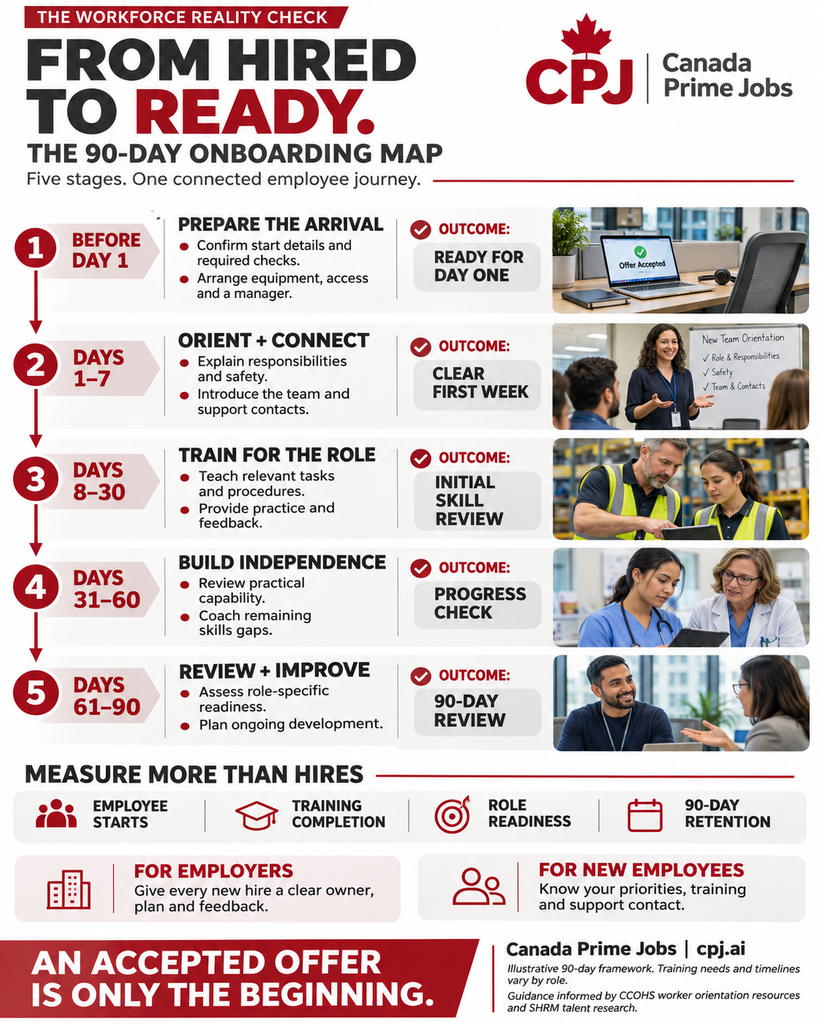
A practical 90-day framework can help employers connect hiring decisions with actual workforce readiness.
The timeline below is an adaptable planning model, not a guarantee that employees will achieve a particular performance level by day 90.
For complex or regulated roles, full proficiency may require substantially longer.
Before Day 1: Recruit, Verify and Prepare
The first phase begins while recruitment is still underway.
Define essential role capabilities, assess candidates consistently and prepare training needs before confirming start dates.
For multiple hires, create a shared record that tracks each person’s progress through hiring and preboarding.
Key questions:
- Has the candidate received accurate information about the job?
- Are legally required checks and credentials being handled appropriately?
- Is the relevant manager prepared?
- Are essential workplace tools and safety arrangements ready?
- Is there a plan for the skills the employee still needs to develop?
Expected output: An accepted candidate with a clear, documented preparation plan.
Days 1–7: Create a Confident and Safe Start
The first week should reduce uncertainty.
Employees need to understand their responsibilities, meet their team, learn how their workplace operates and know where to seek help.
For physical workplaces, appropriate safety orientation is particularly important.
According to CCOHS worker orientation guidance, employers should cover relevant safety rights, workplace hazards, emergency procedures, policies and job-specific training.
However, not all training needs to be delivered on the first day.
Instead, training should be organized around workplace needs and paced so employees can absorb the information.
Expected output: Initial orientation completed, essential access available and relevant training scheduled.
Days 8–30: Build Role-Specific Capability
Once employees understand the workplace, the focus can shift toward performing the actual job.
Managers should identify the tasks that new employees need to complete independently or with supervision.
For example:
- A customer service employee may learn complaint handling and internal support systems.
- A warehouse employee may develop practical inventory and equipment procedures.
- An administrative employee may learn reporting and scheduling workflows.
- A technical professional may become familiar with organizational standards and tools.
- A supervisor may need additional training in team coordination and decision-making.
Training should address genuine gaps, not repeat content the employee has already mastered.
In addition, employees should receive feedback on their progress.
Expected output: Documented role-specific training and an initial capability review.
Days 31–60: Strengthen Independence and Collaboration
During this period, managers can evaluate whether employees understand their responsibilities and can perform increasingly complex tasks at an appropriate level.
Support may involve coaching, mentoring, job aids, refresher training or supervised practice.
For example, a new operations coordinator might begin handling routine scheduling independently while consulting a senior colleague on unusual cases.
Meanwhile, an experienced specialist may focus on learning company-specific processes rather than basic technical knowledge.
The objective is not to apply one identical standard to every worker.
Instead, employees should have clear and fair expectations relevant to their roles.
Expected output: A documented progress review, remaining skills gaps and an updated development plan.
Days 61–90: Evaluate Readiness and Improve the Process
The final stage of the initial 90-day framework should evaluate both employee progress and the organization’s onboarding process.
Managers should ask whether the employee has the tools, support and training needed to perform the role.
Equally important, the organization should identify recurring problems.
For example:
Are new employees repeatedly waiting for system access?
Do certain training topics cause confusion?
Are employees receiving conflicting instructions from different supervisors?
Do recruitment advertisements accurately represent the work people actually perform?
These questions connect onboarding outcomes back to recruitment decisions.
Expected output: A role-appropriate readiness assessment and a practical improvement plan.
The 90-day review should be a milestone, not the automatic end of training or professional development.
The 90-Day Employee Readiness Scorecard
Employers can use a simple scorecard to review whether the onboarding process is functioning as intended.
This example is designed for operational planning rather than legal or clinical assessment.
| Readiness area | What to check | Review point |
|---|---|---|
| Access and equipment | Are necessary tools available? | Day 1–7 |
| Orientation | Have essential policies and safety procedures been covered? | Day 1–7 |
| Role clarity | Can the employee describe their main responsibilities? | Day 7–30 |
| Job-related training | Have essential learning activities been completed and understood? | Day 30 |
| Practical capability | Can the employee perform relevant tasks at the expected level? | Day 30–60 |
| Feedback and support | Has the manager discussed progress and challenges? | Day 30–60 |
| Ongoing development | Is there a plan for remaining gaps? | Day 60–90 |
This is a sample framework. Real evaluations must reflect the specific role, accessibility needs, legal obligations and reasonable training periods.
For example, competency for a regulated healthcare or technical occupation should follow applicable professional and workplace standards.
Measure the Process, Not Only the Employee
A good scorecard also evaluates the employer.
If multiple employees cannot complete their tasks because they lack system access, that is an organizational issue—not necessarily an individual performance problem.
Similarly, if employees consistently misunderstand the same procedure, the training process may need improvement.
A successful workforce strategy should identify both employee development needs and operational barriers.
How to Measure the Real Success of Bulk Recruitment
Counting accepted employment offers is useful, but incomplete.
A more informative system follows employees from recruitment through initial workplace integration.
Six Metrics Worth Tracking
| Metric | Suggested calculation | What it tells you |
|---|---|---|
| Offer acceptance rate | Accepted offers ÷ offers made × 100 | Whether offers are attracting selected candidates |
| Start rate | Employees who start ÷ accepted offers × 100 | Whether accepted offers become actual starts |
| Onboarding completion | Completed applicable milestones ÷ assigned milestones × 100 | Progress through required activities |
| Training completion | Completed required training ÷ assigned required training × 100 | Whether planned learning activities are finished |
| Time to role proficiency | Time until agreed, job-specific capability criteria are met | How quickly employees become ready for relevant responsibilities |
| 90-day retention | Employees remaining after 90 days ÷ relevant starting cohort × 100 | Early employee continuity |
These measurements should be interpreted carefully.
For example, training completion does not automatically prove competence.
Likewise, an employee may remain with an organization for 90 days while still lacking the resources or supervision required to perform the job effectively.
Therefore, combine numbers with manager feedback, employee feedback and appropriate performance evidence.
The Hidden Cost of Poor Coordination
Consider a fictional company that hires 20 employees.
Its managers spend time coordinating interviews, preparing contracts, arranging equipment and scheduling training.
If a selected candidate never starts, some of that effort may need to be repeated.
In addition, another employee may need to cover the unfilled shift or delayed assignment.
However, these costs vary significantly by occupation, organization and location.
Rather than relying on a universal cost-per-hire estimate, employers should calculate their own operational impact.
A simple internal review can consider recruiter hours, manager time, training preparation, equipment costs, overtime and delayed staffing needs.
Better recruitment reporting connects hiring activity with actual operational readiness.
Should You Outsource Recruitment, Headhunting, Training or Onboarding?
For some organizations, internal HR teams can manage the entire process effectively.
For others, a recruitment partner can provide useful capacity or specialized support.
The decision should be based on the work the organization needs help completing.
Recruitment Partner vs. Internal Hiring
| Situation | Internal team may be sufficient | External partner may be useful |
|---|---|---|
| One straightforward vacancy | Existing HR capacity and suitable candidates | When internal capacity is limited |
| Several simultaneous vacancies | Strong internal recruitment operation | Coordinated sourcing and assessment support |
| Hard-to-find specialists | Established professional network | Targeted search or headhunting capability |
| Candidate skills gaps | Existing internal training resources | Additional assessment or development support |
| Multiple onboarding cohorts | Experienced HR and operational teams | Coordination or supporting services, where available |
| Recurring vacancies | Reliable internal talent pipeline | Supplementary candidate sourcing and process support |
An external partner should not replace the employer’s accountability for employment conditions, legal compliance, workplace safety or management responsibilities.
Instead, responsibilities should be clearly allocated in advance.
Seven Questions to Ask a Recruitment Partner
Before engaging a recruitment provider, ask:
- Which job categories, locations and hiring volumes can you actually support?
- How do you source and assess candidates?
- Is specialized headhunting available, and what does it include?
- What training or job-readiness services are available?
- Which onboarding tasks remain the employer’s responsibility?
- How will progress, candidate information and post-hiring support be managed?
- What are the service fees, timelines, deliverables and limitations?
Request written clarification before making a commercial commitment.
The strongest partnership begins with a realistic and shared understanding of the work.
How Canada Prime Jobs Can Support a More Connected Hiring Journey
For employers exploring recruitment and onboarding support in Canada, Canada Prime Jobs (CPJ) offers a useful starting point for discussion.
CPJ’s published service information describes several capabilities that relate to different stages of the recruitment journey.
1. Candidate Verification
CPJ describes processes for reviewing candidate identity, credentials and employment experience.
These activities can help employers examine information relevant to a hiring decision.
Learn more through CPJ’s candidate verification information.
However, the exact verification steps and applicable turnaround times depend on the type of information involved and should be confirmed for each engagement.
2. Skills Assessment and Candidate Matching
CPJ describes general and job-specific assessments intended to evaluate qualifications and relevant capabilities.
This may help employers examine candidate suitability beyond a résumé alone.
Explore CPJ’s assessment services.
As with any assessment process, evaluation should remain relevant, fair and appropriate to the role.
3. Training and Development
CPJ publishes information about personalized training intended to address identified skill gaps, including technical and interpersonal skills.
Training is particularly relevant when a candidate has useful experience but needs additional preparation for particular responsibilities.
Read about CPJ’s training approach.
Employers should discuss which training programs are available, how learning is evaluated and which workplace-specific requirements must be handled internally.
4. Post-Hiring Support
CPJ’s published services also refer to continuing support and professional development after candidates secure employment.
This is relevant because employee success involves more than completing a recruitment transaction.
See CPJ’s service overview and frequently asked questions.
The precise scope of any employer-facing onboarding or post-hiring arrangement should be established before a project begins.
5. Coordinated Employer Hiring Workflow
CPJ describes an employer-facing system for viewing candidate profiles, reviewing assessment information, sending interview invitations and coordinating recruitment activity.
Learn more in The Complete Hiring Process on CPJ.
For businesses considering several hires, these capabilities may be relevant to a discussion about how recruitment workflows could be organized.
What About Bulk Hiring and Headhunting Through CPJ?
If your organization needs to recruit multiple employees, identify a specialized manager, or develop a more coordinated hiring and training plan, CPJ can be contacted to discuss your requirements.
However, availability of dedicated headhunting engagements, specific hiring volumes, full onboarding delivery and U.S. geographic coverage should be confirmed directly with the CPJ team.
An initial discussion can help establish which published services fit your project and whether additional support is available.
The practical value of a recruitment partnership is not just finding more candidates. It’s establishing a clearer path from business needs to suitable people, relevant development and an organized start.
Planning Multiple Hires? Prepare This Brief Before Contacting CPJ
If you’re hiring 10, 20, 50 or more employees, a short project brief can make the first discussion significantly more productive.
Use this template.
| Information | Your answer |
|---|---|
| Company and industry | |
| Hiring location(s) | |
| Number of employees required | |
| Job titles and responsibilities | |
| Essential licences or qualifications | |
| Compensation range and employment terms | |
| Planned start dates | |
| Existing recruitment challenges | |
| Specialized or leadership search needs | |
| Training and onboarding requirements | |
| Current internal HR capacity | |
| Preferred contact person |
Ready to discuss your workforce needs?
Contact Canada Prime Jobs or email info@cpj.ai with the subject line:
Multiple Hiring & Workforce Support Inquiry
Include the number of positions, hiring locations, required skills and target dates.
For projects outside Canada, request confirmation of the relevant service availability before proceeding.
What Job Seekers Should Expect From a Better Onboarding Experience
A structured onboarding process also benefits new employees.
Starting a job can be stressful, especially when responsibilities, systems and workplace expectations are unfamiliar.
A good employer should explain what the employee needs to know and provide appropriate opportunities to learn.
Five Questions New Employees Can Ask
1. What should I focus on during my first week?
Understanding priorities helps avoid confusion.
2. Who should I contact when I need help?
Knowing the right supervisor or support person makes it easier to resolve problems.
3. What training will I receive?
Ask about job-specific learning, safety procedures and available development resources.
4. How will my progress be evaluated?
Clear expectations make feedback more useful.
5. What should I be able to do after 30, 60 or 90 days?
The answer should be realistic for the occupation, experience level and required training.
Not every role will follow the same timeline.
For example, a regulated professional may require formal supervision or additional credential-related steps.
Meanwhile, someone changing careers may need support in translating existing skills into a new environment.
For more career development information, explore CPJ’s training resources and our guide to career changes and future job skills.
Frequently Asked Questions
What is the difference between recruitment and onboarding?
Recruitment involves attracting, evaluating and selecting employees. Onboarding helps newly hired employees integrate into the workplace, understand responsibilities and develop the capabilities needed for their jobs.
Why is bulk hiring difficult?
Recruiting multiple employees increases the coordination needed across sourcing, interviews, candidate communication, employment offers, verification, scheduling and onboarding. The exact challenges depend on the organization and positions involved.
Does onboarding end after the first day?
No. Orientation may take a few hours or days, while onboarding can extend through the first 30, 60 or 90 days and sometimes much longer.
When should a company use headhunting services?
Targeted search may be useful for senior, specialized or hard-to-fill roles where suitable professionals are unlikely to be reached through ordinary applications alone.
Is training better than recruiting new employees?
Neither is universally better. Training can address developable skills gaps, while external recruitment may be needed when a business lacks specific capacity or expertise. Often, a combined approach is useful.
What should employers track during onboarding?
Useful measures include start rates, completion of required orientation and training, job-specific readiness, employee feedback and early retention. These should be interpreted alongside operational conditions and role requirements.
Can CPJ help companies recruit multiple employees?
CPJ describes recruitment, candidate assessment, verification, training and post-hiring support services. Employers can contact the company to discuss multi-position needs and confirm project-specific capacity, locations, scope and terms.
Does CPJ provide headhunting and full onboarding services in the United States?
The public information reviewed does not independently confirm those specific service commitments. Employers should contact CPJ directly to establish whether suitable arrangements are available for their required roles and locations.
Final Thoughts: An Accepted Offer Is the Beginning, Not the Finish Line
Recruiting the right people remains essential.
However, businesses also need to prepare employees for the work they are expected to perform.
That means connecting workforce planning, candidate assessment, specialized recruiting when necessary, training and onboarding.
For job seekers, a clear and supportive transition can make a meaningful difference to the first months in a new role.
For employers, a connected recruitment and onboarding process creates better visibility into whether the organization is actually building the workforce it needs.
The goal isn’t simply to hire 20 people. It’s to help 20 people start with clarity, the right preparation and a practical path to success.
If your organization is planning multiple hires, expanding into new locations or exploring recruitment and training support, start a conversation with Canada Prime Jobs.
You can also read our related 30-Day High-Volume Hiring Playbook for the earlier stages of workforce planning and recruitment.
Sources and Further Reading
Research reviewed November 2026. Figures from surveys reflect the participants and populations described by their publishers, not all employers across Canada and the United States.
- SHRM — 2026 Talent Trends: Recruitment challenges, employee retention and workforce development.
- SHRM — 2026 Talent Trends Research Announcement: Survey methodology and key U.S. findings.
- Onboarded — State of High-Volume Onboarding 2026: Survey of 404 high-volume hiring and onboarding leaders.
- Canadian Centre for Occupational Health and Safety — Orientation for Workers: Orientation, onboarding and workplace preparation.
- CCOHS — Worker Orientation Checklist: Practical orientation requirements.
- SHRM — New Hire Integration and Onboarding: Onboarding beyond introductory paperwork.
- Canada Prime Jobs — About Us: Published overview of recruitment and development services.
- Canada Prime Jobs — Training Services: Candidate training and development information.
- Canada Prime Jobs — The Complete Hiring Process: Employer recruitment platform workflow.
This article is educational. Employment laws, professional licensing, immigration eligibility, privacy obligations and occupational safety requirements differ by jurisdiction. Service availability and commercial terms should be confirmed directly with the provider.