

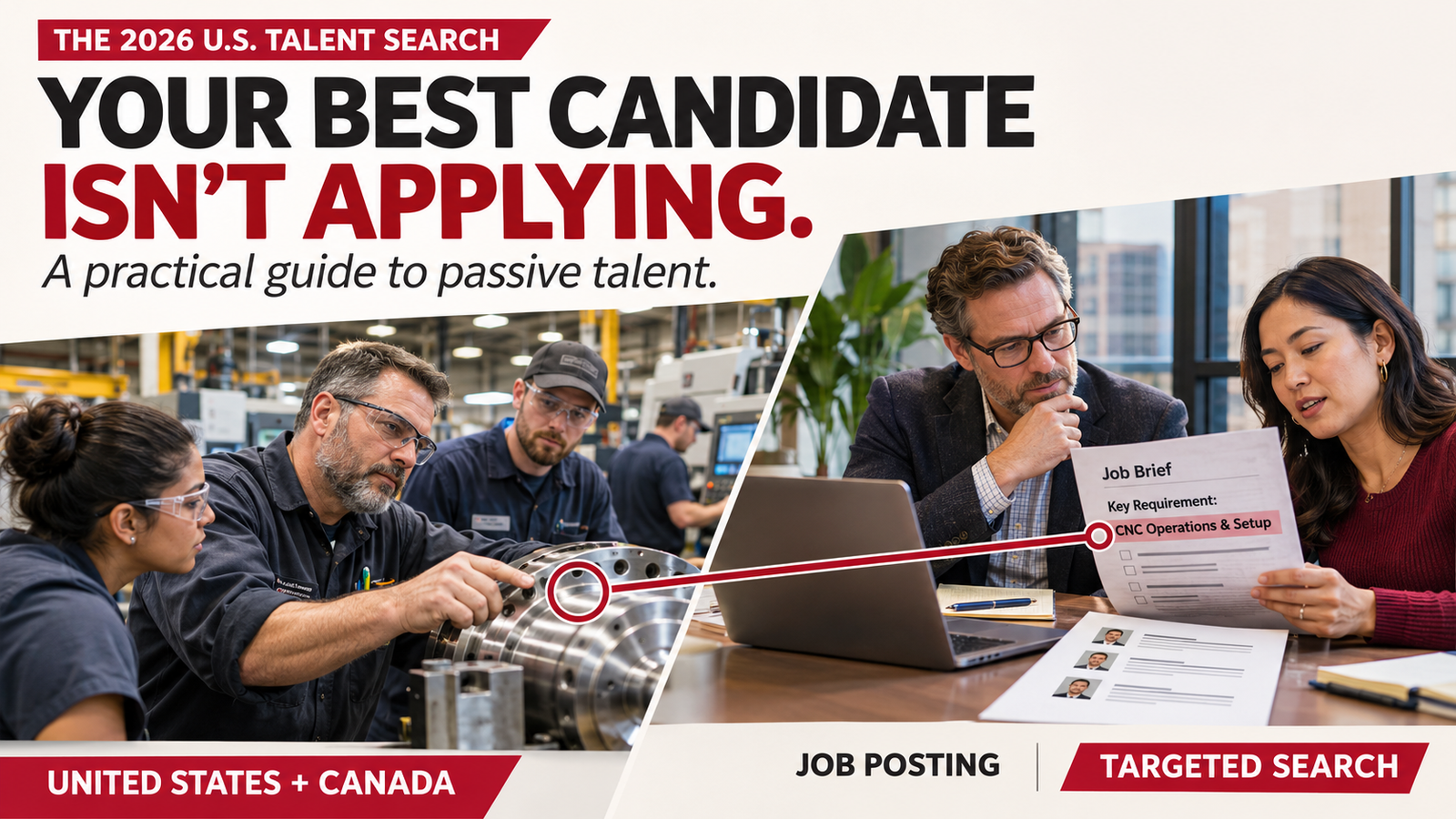
How to Recruit Passive Candidates in the U.S. (2026): A Practical Headhunting Playbook
The best person for your next role may never apply. Here is how to find them without turning recruitment into a guessing game.
If you are trying to recruit passive candidates in the United States, publishing another job advertisement may not be enough. Some qualified professionals are doing good work for their current employers. They are not browsing job boards, yet they might consider an opportunity that genuinely improves their career.
Imagine a U.S. manufacturer looking for a maintenance supervisor who knows a specific production system. Dozens of applications arrive, but few demonstrate the experience the business needs. Meanwhile, a suitable professional at another organization has never seen the opening.
That is the practical problem headhunting is designed to address: reaching relevant people who are not actively applying, then giving them a credible reason to talk.
The wider labour market provides important context, although national totals cannot tell us whether an individual occupation is hard to fill. In its November 3, 2026 release, the U.S. Bureau of Labor Statistics reported approximately 7.5 million job openings in September 2026 and 5.4 million hires during that month. Openings are measured at a point in time; hires are measured over the month, so these numbers must not be treated as an application-to-hire conversion rate.
Meanwhile, LinkedIn’s Future of Talent Report 2026 identifies trust and evidence of skills as growing themes in talent acquisition. Its analysis says conversations about trust among U.S. recruiters on LinkedIn doubled year over year. This is a platform-specific observation, not evidence that hiring fraud doubled nationwide.
So how should employers respond? This guide explains how to recruit passive candidates across industries, evaluate their actual skills, avoid common outreach mistakes and decide when a recruitment partner may be helpful.
Quick answer: Define the essential work, map relevant talent pools, contact individuals respectfully, share a compelling and truthful opportunity, assess skills consistently and keep the hiring process efficient. Do not assume that an impressive profile alone proves job readiness.
What Are Passive Candidates?
A passive candidate is someone who is not actively seeking a new position but may be open to a relevant opportunity. They may already be employed, be engaged in consulting work or simply not be searching at the moment.
In contrast, active candidates are currently looking for work and may be responding to advertisements. Neither group is inherently more capable. The difference is how an employer reaches them.
For example, a restaurant group may advertise for restaurant managers while discreetly approaching experienced multi-location leaders. A healthcare organization may advertise a role while exploring professional networks for licensed specialists. A logistics company might combine an open search with direct outreach to experienced dispatch managers.
Read our earlier guide, Headhunting vs Recruitment in 2026, for a broader comparison of hiring, retraining and internal mobility.
Why Recruit Passive Candidates in the U.S. in 2026?
There are three practical reasons to recruit passive candidates for certain vacancies:
- Some relevant workers are not looking. Posting the role will not necessarily reach them.
- Specialized skills may cross industries. A candidate with the right operational experience may have a different job title from the one in your advertisement.
- An exploratory conversation reveals motivations. A candidate may prioritize leadership scope, schedule stability, location, learning or an achievable career step—not merely a higher title.
However, direct sourcing is not automatically better than advertising. For high-volume, entry-level or broadly accessible roles, a structured recruitment campaign may be more efficient. The best method depends on the occupation, location, compensation and available candidate pool.
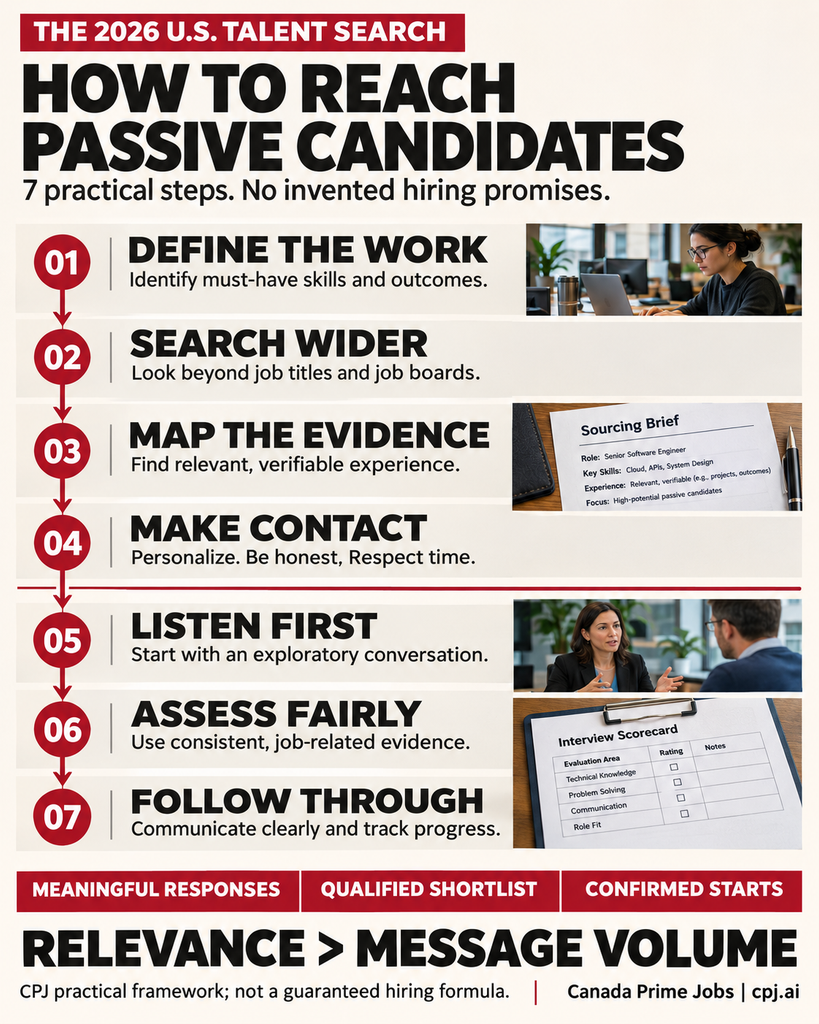
How to Recruit Passive Candidates: The 7-Step Playbook
Step 1 — Write a Capability Brief, Not a Wishlist
Before searching, ask what the person must actually accomplish in the first six to twelve months.
Define the problem, the responsibilities, the location or shift requirements, the realistic salary range, and any essential licence or work-authorization requirements. Then separate genuine requirements from skills that could be learned on the job.
| Must be confirmed | Can be developed or evaluated | Evidence to request |
|---|---|---|
| Legally required licence or credential | Familiarity with one software product | Relevant project or work example |
| Essential job-specific capability | Company-specific processes | Explanation of the candidate’s role |
| Required location or shift availability | A preferred but nonessential tool | Demonstration or structured interview |
Why it matters: Employers who cannot explain the work clearly may struggle to persuade a capable professional to consider a move.
Step 2 — Search Beyond Job Titles
To recruit passive candidates effectively, look for evidence of relevant work rather than exact title matches.
Potential sources include professional associations, trade networks, alumni groups, public portfolios, industry events, employee referrals and appropriate professional platforms. For some roles, consider adjacent industries with transferable experience.
Example: An employer seeking a warehouse operations leader might also evaluate distribution supervisors who have managed safety, scheduling, inventory and teams. The actual responsibilities matter more than a title match.
Use legitimate sourcing methods, respect privacy and contact preferences, and avoid collecting or using sensitive personal information unrelated to the job.
Step 3 — Build a Small, Evidence-Based Talent Map
Record what makes each potential candidate relevant before contacting anyone. A useful talent map might include:
- The specific capability that matches the role.
- A public, job-related project or professional background supporting that match.
- The candidate’s likely location and applicable work arrangements, where legitimately available.
- A realistic reason the new opportunity might interest them.
- The next appropriate contact step and response status.
Do not rank people by assumptions about age, ethnicity, family situation or other protected characteristics. Likewise, do not infer that being employed makes someone better than a job seeker.
Step 4 — Make the First Message Worth Reading
Generic messages often fail because they say nothing useful about the position. When you recruit passive candidates, the opening message should explain why this person, why this work, and why the conversation is low pressure.
Copy-and-adapt outreach template:
Subject: A possible [role] conversation in [location]
Hi [First Name],
I came across your experience with [specific, verifiable skill or project]. We’re exploring candidates for a [job title] role in [location/work arrangement], focused on [one concrete responsibility].
The position offers [accurate, approved information about compensation, scope or flexibility]. Would you be open to a brief, no-pressure conversation to see whether it aligns with your goals?
If the timing isn’t right, I completely understand.
[Your name and verifiable employer/recruitment contact details]
Be honest about pay, working arrangements, the employer’s identity and the stage of the search. If information cannot yet be shared, say so rather than creating artificial urgency.
Step 5 — Start With an Exploratory Conversation
A passive professional may not have an updated résumé. Avoid making a lengthy application form the price of an introductory discussion.
Instead, ask:
- Which projects or responsibilities are most important to you now?
- What would make a new opportunity worth considering?
- Which type of leadership, working arrangement or career development do you want?
- What would you need to know before entering a formal selection process?
LinkedIn’s practical guidance on recruiting passive candidates similarly emphasizes personalizing the conversation and reducing unnecessary process friction.
Step 6 — Verify Skills With a Fair, Job-Related Assessment
After mutual interest is established, assess the person against the same core capabilities used for other applicants. Depending on the occupation, an appropriate method might be a structured interview, a short work sample, a portfolio discussion or a qualification check.
For example, ask an operations candidate to describe how they handled a real scheduling constraint. Ask a cybersecurity candidate to explain a relevant incident-response decision without disclosing confidential employer information. Ask a customer service manager to walk through how they coached a team during a service disruption.
Important: Assessments must be relevant, proportionate and accessible. The U.S. Equal Employment Opportunity Commission (EEOC) explains that hiring tests and selection procedures can raise discrimination concerns if applied improperly or if they unjustifiably exclude protected groups. Review applicable federal, state and local requirements, including accommodations and privacy obligations.
Step 7 — Keep the Process Moving and Record Outcomes
To recruit passive candidates successfully, follow up when promised, explain the next stage and make decisions within a realistic timeline.
Track more than the number of people contacted. Consider these operational measures:
| Measure | What it helps you learn |
|---|---|
| Relevant profiles identified | Whether the search criteria are realistic |
| Meaningful responses | Whether outreach resonates |
| Exploratory conversations | Whether candidates see a possible fit |
| Job-related shortlist | Whether candidates meet the requirements |
| Offers accepted and starts confirmed | Whether the process converts interest into employment |
These are suggested process indicators, not industry benchmarks or guaranteed conversion rates. Review candidate feedback and refine the brief when the evidence shows a mismatch.
When Should You Use Headhunting, General Recruitment or Both?
| Hiring situation | Practical starting approach | What to watch |
|---|---|---|
| One rare specialist or senior role | Targeted search plus appropriate advertising | Confidentiality, role clarity and candidate engagement |
| Ten similar operational vacancies | Coordinated recruitment and screening | Candidate communication, scheduling and start dates |
| Twenty hires plus two hard-to-find managers | High-volume recruitment and targeted search | Separate workflows with one overall hiring plan |
| Existing employees may have the capabilities | Internal mobility and upskilling review | Fair access to opportunities and realistic training time |
These examples are hypothetical. The best approach may combine several methods.
If your organization is hiring multiple employees, our High-Volume Hiring in 2026: 30-Day Playbook covers workforce planning, candidate tracking and coordinated assessment. The timelines there are illustrative, not guaranteed.
The Two-Week Passive Candidate Search Pilot
Before committing to a large sourcing campaign, consider an illustrative two-week pilot:
Week 1 — Clarify and map: Agree on essential skills, compensation, geography, approved communication channels and the assessment plan. Research a manageable group of relevant professionals and prepare personalized outreach.
Week 2 — Engage and learn: Begin respectful outreach, hold exploratory discussions with interested people and review whether the role proposition is credible and competitive. Document the questions candidates raise and decide whether to adjust the brief.
This is a planning example. Some searches take considerably longer, particularly for senior, regulated or highly specialized positions.
What Job Seekers Should Know When a Headhunter Contacts Them
Being approached unexpectedly can be flattering, but it is sensible to verify the opportunity before sharing personal information.
Ask five questions:
- Who is the employer or search firm? Can you verify its website and the recruiter’s identity independently?
- What is the real job? Ask about responsibilities, location, reporting line and work arrangement.
- What is the compensation framework? Seek honest information as early as reasonably possible.
- What will the selection process involve? Clarify interviews, assessments and expected next steps.
- What information will be requested? Do not send banking credentials, passwords or payments for a job opportunity.
Explore our guide to fake job postings and recruiter scams for a practical verification checklist. You can also browse CPJ job listings, checking each posting’s status and eligibility before applying.
How CPJ May Support a Complex Hiring Project
For employers, recruiting involves more than identifying profiles. A structured process also needs candidate information, consistent assessments, clear communication and—where relevant—training or post-hire support.
According to its published service pages, Canada Prime Jobs (CPJ) describes services including candidate verification, skills assessments, training and an employer hiring workflow. These components may be useful when planning an organized recruitment project. Specific services and delivery details should be confirmed before engagement.
For a business considering a specialized search in the United States, CPJ can be contacted to discuss the requirement and assess whether an appropriate collaboration is available. Its publicly reviewed pages do not establish guaranteed U.S.-wide executive-search operations, a specific number of placements, a fixed search timeline or U.S. employment-law representation. Availability, geographic scope, commercial terms and responsibility for compliance must be agreed before work begins.
If you need one difficult-to-find specialist, a group of new employees or a combination of both, start with a clear hiring brief.
Contact Canada Prime Jobs about your hiring project or email info@cpj.ai with the subject “U.S. Talent Search / Hiring Partnership”. Include:
- Job titles and number of positions.
- U.S. states or cities, plus onsite/hybrid/remote requirements.
- Essential skills, credentials and work-authorization requirements.
- Approved compensation range and desired timeline.
- Whether you need targeted sourcing, multiple hires, assessments or training coordination.
This gives both sides enough information to determine whether a suitable, clearly scoped collaboration is possible.
Frequently Asked Questions
What is a passive candidate?
A passive candidate is a professional who is not actively applying for jobs but may be open to the right opportunity. Passive status says nothing by itself about skill or quality.
How do you recruit passive candidates who are not looking for work?
Start with specific, job-related research, then send a truthful personalized message explaining the role and why the candidate’s experience is relevant. Keep the first conversation exploratory and respect a refusal.
Does headhunting work for industries outside technology?
Yes. Targeted outreach can be relevant to healthcare, manufacturing, logistics, finance, hospitality, construction, retail and many other fields. It is particularly useful when specific experience, credentials or leadership capabilities are hard to reach through advertisements alone.
Is headhunting better than a job advertisement?
Not necessarily. Headhunting can reach people who are not actively applying, while advertisements provide an open route for interested candidates. Many employers benefit from using both appropriately.
Can a company use headhunting for high-volume recruitment?
Yes, selectively. A company might use direct sourcing for a few specialized roles and a coordinated recruitment campaign for a larger group of related vacancies. A single approach is not optimal for every position.
What should employers ask a U.S. headhunting partner?
Ask about the search scope, relevant occupation experience, sourcing and assessment methods, candidate privacy, fees, exclusivity, candidate ownership, reporting, service timelines and responsibilities under applicable law. Obtain clear written terms.
Can CPJ guarantee U.S. headhunting or bulk hiring results?
No such guarantee should be assumed. Employers can contact CPJ to discuss a proposed U.S. search or multiple-hire project and confirm the service scope, availability and terms before proceeding.
Final Takeaway: Better Search Begins Before the First Message
To recruit passive candidates well, an employer must make a credible offer, demonstrate respect for the candidate’s time and assess genuine capability. The goal is not to send more messages; it is to start better conversations with people who may be right for the work.
Whether your next challenge involves one specialist or a broader hiring campaign, role clarity, relevant evidence and a transparent process are the foundations of a more useful search.
Employers: Discuss a recruitment project with CPJ.
Job seekers: Explore current opportunities and review our job-offer verification guide.
Sources and Editorial Notes
- U.S. Bureau of Labor Statistics — JOLTS, September 2026 (published November 3, 2026): monthly national labour market data.
- LinkedIn — Future of Talent Report 2026: platform research and recruiter conversations about hiring trust.
- LinkedIn — How to Recruit Passive Candidates: practical candidate engagement guidance.
- U.S. EEOC — Employment Tests and Selection Procedures: equal employment opportunity considerations.
- U.S. EEOC — Private-Sector Employer Best Practices: fair, job-related recruiting and interviews.
Research reviewed November 2026. The job examples, matrices and two-week pilot are original editorial frameworks, not survey results, actual CPJ client projects or guarantees. Regulations and commercial arrangements vary by state, jurisdiction and industry.